Showing posts with label Nativity. Show all posts

Thursday, December 5, 2019

Christmas Is What We Make It - Understanding the icon of the Incarnation (Nativity)


Awake! God is becoming man. He wants to show us the path to paradise.

When I look around me the signs of this season to not point to such a great event. The images that I found with a google search are mainly about Santa Clause, reindeer, Elves, presents, decorated trees, office parties... Seems like the season is all about this world’s pleasures. Where is Christ? What kind of Christmas will WE make?

To tell the truth, it seems like most us us are asleep spiritually. We enjoy Christmas time with all its celebrations. But in the midst of these God is distant from us, we are unaware of our sinfulness, we rarely pray, only attend church periodically out of duty, and only periodically participate in the sacrament when we do come, and many have never been to confession. Maybe the secular Christmas celebration fits us. Are we are making Christmas fit what we believe?

We all need to be awakened to the Truth!

What is Christmas all about? Are we celebrating the birth of a baby boy? No! We are celebrating the beginning of the way to our salvation. God becomes man, a human being who is also God! Christmas is about the Incarnation of our Lord, Savior, our Creator. God becomes man to show us our true potential created in His image and likeness. After His birth He lives with humility, heals, teaches and then is unjustly and voluntarily killed by Crucifixion, suffers, is  beaten, humiliated, and hung naked nailed to the Cross. His life and death was to show us our path to paradise. After His death He is resurrected, defeating death with His death. He then Ascends into Heaven and is seated at right hand of God. After teaching His disciples the mysteries sends the Holy Spirit empowering them to establish ecclesias, gatherings of believers, communities where they can grow spiritually. This all begins with the event we call Christmas. We are celebrating our very entrance into the pathway of our salvation.

The festival approacheth, the most to be revered, the most awesome, and which we might justly term the centre of all festivals,—that of the birth and manifestation of Christ in the flesh.
Saint John Chrysostom 

Let’s not be lulled to sleep with all the secular attachments that merchants have created to stimulate our shopping habits and desires. Our secular values have stripped the true meaning from all aspects of the activirties of this season.

How was Christmas celebrated traditionally?
It began with a fast, an inner period of reflection, preparing ourselves to become more worthy to receive the King. It was only after the Christmas Day that we celebrated, exchanged gifts, visited friends and relatives. This is the 12 days of Christmas which are fast free and set aside for celebration of this great event. Before this awesome day we are preparing to receive God as man and then, after His birth, to glorify His coming for our salvation. The celebration ends with another important celebration, Epiphany, the baptism of Christ and the beginning of His ministry.

Nativity Icon
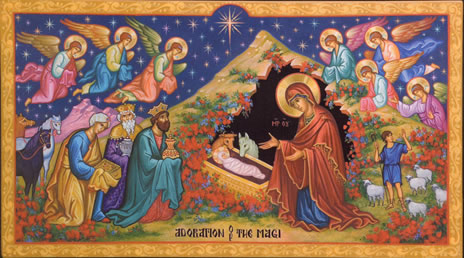
To better understand this most significant event in the history of mankind let’s examine the icon that tells the story of the Incarnation. Not just the birth of Jesus the man, but the Incarnation of God! Looking at the icon it appears as a scene beyond time. The immediate focus is Mary, calling us to better understand her role. The scene is totally different than that portrayed in most western nativity scenes. Let’s explore it. It tells the entire story in one image.

There are eight parts to this icon: the birth place, the star, the mother of God—the Theotokos, Christ, Joseph and the devil, the Angels, shepherds, wise men,  and the midwives.

Let’s look at each of these in detail.


Christ:  
He is wrapped is swaddling cloths which is how a person was normally wrapped after birth. The infant was wrapped in a cloth that was four to five inches wide and five to six yards long. He would be wrapped like this for seven days and then cleansed and rewrapped, a process that lasted fourth days. They believed at that time that this would help the soft bones of the child grow straight. It is also similar to how a person is wrapped for burial after death. This symbolizes the destiny He faces like all of us, so He can show us the way to life beyond death. In HIs Resurrection He will show us how we too can claim victory over death with faith and following Him.
St Ephram the Syrian writes: His swaddling clothes gave a robe of glory to human beings.
Notice how the manger is not a traditional food trough for animals but appears as a tomb. This is intended to remind us that Christ came into the world to die for us and then show us victory over death in the Resurrection. 
The animals are an Ox and a donkey. This comes from a prophesy in the Old Testament in book of Isaiah: “The ox knows his owner, and the donkey his masters crib (Isaiah 1:3). They are show providing warmth to Jesus by their breath.

Birth place:  
The birth of God took place in dark cave shown in the center of the icon. When Mary and Joseph arrived in Bethlehem to pay their taxes they found no room in traditional lodging places. By God’s providence they found shelter in cave. In the area of Bethlehem caves were often used as places to shelter the animals. The cave also is a symbol of the coming of God as a human being to bring light into the darkness of our souls, our ignorance of our sinful condition, and to give light to the way out of darkness to eternal paradise. The fact that it was also a stable, also has important symbolism. You can see the animals looking at the Christ child. Where animals were kept was a smelly place, not a desirable place to stay, let alone give birth to a child, but this place was not chosen by chance because it shows the humility of Christ. He could have chosen to be born in a palace, but He was coming to show us that the way to paradise is based on humility. He is showing us that this needs to be an important value in our lives, to not seek riches or honors, or to be seen as better than others. 
“The Good Shepherd, He who lays down His life for His sheep, came to seek that which had strayed...He humbles Himself, that He may raise up with Himself the soul that was tottering to a fall under a weight of sin....[for] my perfection and return to the first condition of Adam.” Saint Gregory the Theologian, oration 38
The dark background in the cave can be explained by the birth of Christ being like the spiritual light that shines forth in the shadow of death that surrounds all mankind. The black mouth of the cave symbolizes the world filled with sin from the Fall of mankind, and with the the birth of the Savior, the “Son of righteousness,” it is now enlightened with a clear path to return to paradise.

Mary, The Theotokos:  
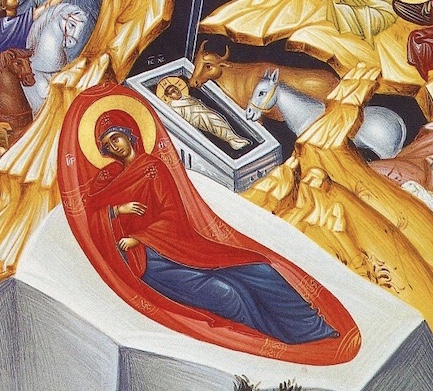
Notice how she is in the middle and focal point of the icon. Without her there would not be the Incarnation. All that follows would not have happened. She was especially prepared by God to be pure so she could give flesh to the Son of God. She is looking away to show her humility. This was a miraculous birth by a virgin through the work of the Holy Spirit.
“When God became known to us in the flesh, He neither received the passions of human nature, nor did the Virgin Mary suffer pain, nor was the Holy Spirit diminished in any way, nor was the power of the Most High set aside in any manner, and all this was because all was accomplished by the Holy Spirit. Thus the power of the Most High was not abased, and the child was born with no damage whatsoever to the mother’s virginity.” - St. Gregory of Nyssa

The Star:  
In the top center you can see a blue light which represents the star. This is the star that appeared in the East at the time of the Annunciation and led the wise men to Christ for about nine months. This was not a real star but the work of the Holy Spirit to show the way to Christ. It behaved differently than anything scientists have ever observed. It moved, it stopped, it ascended and descended, it changed direction. Some say it was Archangel Gabriel. Notice how it points directly to the Christ Child. Saint John Chrysostom says, “no natural star could have traversed such a course, nor could I have shone so brilliantly at midday; and, furthermore, it stood still over the Child.
In the icon it points directly to the cave. It is a long ray which connects part of a sphere that goes beyond the limits of the icon. This is a representation of the heavenly realm, signifying that the star and this ray are a messenger from the world on high.
 It brings our attention to Christ and indicates His divine nature.


Angels:  
Above Christ we can see a multitude of angels gathered to glorify the Incarnation. They have come also to herald the Good News of the birth of our Savior. This points out how this event is not just the birth of a child, but the Incarnation of God Himself. God has become man. Rejoice!


Shepherds:  
Even the shepherds came to glorify God. They were the first sons of Israel to come to worship the Christ Child. The shepherds watched over flocks of lambs destined for sacrificial services in this area where the birth took place. They are being told of the Incarnation by an angel. They were told: “ Be not afraid; for I bring you good news of a great joy which will come to all people; for to you is born this day in the city of David a Savior, Who is Christ the Lord. And this will be a sign for you: you will find a babe wrapped in swaddling cloths elating in a manger” (Lk 2:10-12).The shepherds heard the angels singing: “Glory to God n the highest, and on earth peace, goodwill among men.” (Lk 2:14)
Shepherds are simple people. Their presence indicates that God came for all people and not just those who are privileged. There is one shepherd playing a reed flute showing that music is appropriate for glorifying God.

Wise men or Magi:  
There are also three men on horses. One is a beardless youth, another middle aged and the third an old man They are referred to as Magi or wise men, member of a Persian class of  priestly scholars who were very powerful among the Persians. They were occupied with the study of medicine, philosophy, natural sciences and scientific study of the stars. They believed there was a mystical influence of the stars on earthly things so they were constantly studying the heavens for new signs. They were aware of the prophecies of Daniel, especially the one concerning the time of the coming of Christ. (Dan 9:25,26). They were also familiar with Barlaam’s prophecy about the star shining forth from Jacob (Num 24:17). When this unusual bright star appeared to them they knew it was a sign of a great event. Recognizing its significance they vowed to follow it to the scene of the Incarnation. They followed the star “till it came to rest over where the young Child was (Mat 2:11)” with His mother.  They brought with them gifts of gold, frankincense and myrrh, as a way of giving thanks to God. In the hymn for the forefeast we find the following :”The kings, first fruits of the nations, bring three gifts,...by myrrh they point to Thy death, by gold to Thy royal power, by frankincense to the dignity of Thy divinity.” Gold is also know as a symbol of wisdom, frankincense as power of prayer as it is burnt before God and myrrh the mortification of the body.
These men came some time after the actual birth, about two years later. This is a characteristic of icons. They capture what is necessary to tell the whole story.
This scene also tells us by their example that all scientific study is meant to lead us toward the true God.

Midwives: 
In the lower left we can seen the midwives preparing the bath water to bathe the new born child. This was done out of tradition as there was no blood in the birth. The bathing does not signify that Christ was unclean and in need of purification. This was done to show His true humanity. The two women are know as Zelomi and Salome. Salome is related to Mary. She is Mary’s mother’s sisters daughter, a first cousin. The duties of a midwife were washing the new born, rubbing it with salt, water and oil, and then wrapping it in swaddling bands.
This scene shows the full humanity of the Incarnate Son of God. Jesus was fully human in all regards except He was without sin. It is also symbolic of baptism which all members of His Church go through for spiritual cleansing of sins and a transformation with the Holy Spirit planted in their heart with Chrismation.


Joseph and the devil: 
In the lower right we have another scene with Joseph, an old man and another with a cane. Joseph is shown with a halo. He was an old man because he was of age when he was appointed to be the protector of Mary so she could live life as a virgin. He was probably 70-80 years old at this time. He is pondering this whole situation because he was not the biological father of the child. He is being tempted by the old man with the cane who is trying to raise doubts in his mind: How is it possible for a virgin to bear a child? This man is Satan, who is saying, “this is against all natural laws you fool!s!” The difficulty Joseph faced is no different from ourselves who have difficulty grasping the reality of the virgin birth and God becoming man while still retaining His divinity. The Incarnation of God goes beyond reason.
The tree you see to the left of Joseph is a symbol of the tree of Jesse. This refers to Isaiah  11:1-2, “But a shoot shall spout from the stump of Jesse, and from his roots a bud shall blossom. The spirit of the Lord shall rest upon Him.” In the flesh, Jesus can trace his ancestry through His mother and adoptive father Joseph, all the way back to Jesse.

Adore the birth by which you were loosed from the chains of your birth (Luke 2:1-5), and honor little Bethlehem, which has led you back to Paradise.... With shepherds glorify Him; with angels join in chorus; with archangels sing hymns. Let this Festival be common to the powers upon earth. - St Gregory the Theologian

“It is on this day that, throughout the entire inhabited world, the Holy Church brings to our remembrance and observes that most majestic and sublime of mysteries: the Incarnation of God the Word from a Most-pure virgin through an outpouring of, and an overshadowing by, God's Holy Spirit. Wondrous, inexpressible, and awesome is this mystery, both for the exalted and all-contemplating celestial minds of those who dwell in the heavens: the ranks of the angels, – and for the minds of men, enlightened by the Holy Spirit. Imagine: the unoriginate God from Whom everything received the commencement of its existence: the Angels, and the human race, and the entire world, both visible and invisible, – takes a beginning in His humanity. He Whom the heavens cannot contain – is contained in a virginal womb. God – becomes an infant, and is borne upon the arms of a Mother. He Who nourishes every breath – is nourished by paps.”
Saint John of Konstradt

Make this Christmas to be about the Incarnation of God Himself as Jesus Christ.


Apolytikion: (Fourth Tone)
Your birth, O Christ our God, dawned the light of knowledge upon the earth. For by Your birth those who adored stars, were taught by a star, to worship You, the Sun of Justice and to know You, Orient from on High. O Lord, glory to You.

Kontakion: (Third Tone)
Today, the Virgin bears Him who is transcendent, and the earth presents the cave to Him who is beyond reach. Angels, along with shepherds glorify Him. The Magi make their way to Him by a star. For a new child has been born for us, the God before all ages.

Reference: The icon used can be obtained from the Orthodox Monastery Store, made by the nuns of the Paracletos Greek Orthodox Monastery in Abbeville, SC


Monday, December 22, 2014

Christmas Reflection


St. Ephrem the Syrian writes, “The Lord of David and Son of David hid His glory in swaddling clothes. His swaddling clothes gave a robe of glory to human beings.” This week we celebrate this most incredible event where God becomes man and yet is still God. He came in a most humble way delivered in a stable and wrapped in simple clothing. Yet as Saint Ephrem says, this simple beginning gave to all mankind robe of glory. What is this robe of glory?

In today's world it is hard to focus on the true meaning of this mystical event with all the parties and the mad gift giving, the coming of Santa Clause and the unending football games on TV. We are distracted even more now by our cell phones, iPads and instant movies. We no longer complain about not having a television but not having one that is big enough. How do we make this event relevant this week?

When we think of this robe of glory that He gave us we must first think back to His nature and the way He was brought into the world. He came in humility and left this world in humility. His robe was not made of golden threads. His birth and subsequent life had noting to do with material well being. He lived with a pure heart, one that glorified God, one that shone for all to see.

We must begin our reflection on this day with total humility. We must admit our weaknesses, our ways that deviate from what He taught and demonstrated to us. We must acknowledge our pride and our desire to hide our dirty inner clothing with fancy outer clothing. We must admit that we do not have this robe of glory that He brought for all humankind. We must make ourselves feel His humility.

With this reflection we must also remember the unending and limitless love He has for all His children. Acknowledging His love for us we can be joyful that we are held in His loving and merciful arms. We can be joyful that we are so important to God and in our knowledge that He will do anything to guide us towards His perfection.  He holds for us a robe of glory.

Let us rejoice in this glory that awaits us. Let us recognize Jesus for Who He really is, God Incarnate. Let's lay aside all our doubts about God and His Church. Let us for a short moment try on that robe of glory. Let us experience His peace and love of all humankind.

Joy to the world, the Lord has come!  Glorify Him. Follow Him.

Saturday, December 24, 2011

THE WORD BECAME FLESH


A Sermon by St John of Kronstadt on the Nativity of Christ

The Word became flesh; that is, the Son of God, co-eternal with God the Father andwith the Holy Spirit, became human – having become incarnate of the Holy Spirit andthe Virgin Mary. O, wondrous, awesome and salvific mystery! The One Who had nobeginning took on a beginning according to humanity; the One without flesh assumedflesh. God became man – without ceasing to be God. The Unapproachable Onebecame approachable to all, in the aspect of an humble servant. Why, and for whatreason, was there such condescension [shown] on the part of the Creator toward Histransgressing creatures – toward humanity which, through an act of its own will hadfallen away from God, its Creator?

It was by reason of a supreme, inexpressible mercy toward His creation on the part ofthe Master, Who could not bear to see the entire race of mankind – which, He, increating, had endowed with wondrous gifts – enslaved by the devil and thus destined foreternal suffering and torment.

And the Word became flesh!...in order to make us earthly beings into heavenly ones, inorder to make sinners into saints; in order to raise us up from corruption intoincorruption, from earth to heaven; from enslavement to sin and the devil – into theglorious freedom of children of God; from death – into immortality, in order to make ussons of God and to seat us together with Him upon the Throne as His royal children.O, boundless compassion of God! O, inexpressible wisdom of God! O, great wonder,astounding not only the human mind, but the angelic [mind] as well!

Let us glorify God! With the coming of the Son of God in the flesh upon the earth, withHis offering Himself up as a sacrifice for the sinful human race, there is given to thosewho believe the blessing of the Heavenly Father, replacing that curse which had beenuttered by God in the beginning; they are adopted and receive the promise of an eternalinheritance of life. To a humanity orphaned by reason of sin, the Heavenly Fatherreturns anew through the mystery of re-birth, that is, through baptism and repentance.People are freed of the tormenting, death-bearing authority of the devil, of the afflictionsof sin and of various passions.

Human nature is deified for the sake of the boundless compassion of the Son of God;and its sins are purified; the defiled are sanctified. The ailing are healed. Upon those indishonour are boundless honour and glory bestowed.
Those in darkness are enlightened by the Divine light of grace and reason.

The human mind is given the rational power of God – we have the mind of Christ (Cor.2, 16), says the Holy apostle Paul. To the human heart, the heart of Christ is given. Theperishable is made immortal. Those naked and wounded by sin and by passions areadorned in Divine glory. Those who hunger and thirst are sated and assuaged by thenourishing and soul-strengthening Word of God and by the most pure Body and DivineBlood of Christ. The inconsolable are consoled. Those ravaged by the devil have been –and continue to be – delivered.

What, then, O, brethren, is required of us in order that we might avail ourselves of all thegrace brought unto us from on high by the coming to earth of the Son of God? What isnecessary, first of all, is faith in the Son of God, in the Gospel as the salvation-bestowing heavenly teaching; a true repentance of sins and the correction of life and of heart; communion in prayer and in the mysteries [sacraments]; the knowledge andfulfillment of Christʼs commandments. Also necessary are the virtues: Christian humility,alms-giving, continence, purity and chastity, simplicity and goodness of heart.

Let us, then, O brothers and sisters, bring these virtues as a gift to the One Who wasborn for the sake of our salvation – let us bring them in place of the gold, frankincenseand myrrh which the Magi brought Him, as to One Who is King, God, and Man, come todie for us. This, from us, shall be the most-pleasing form of sacrifice to God and to theInfant Jesus Christ.
Amen. 

Thursday, December 22, 2011

What was the New Life Christ's Birth Brought?


The birth of Jesus, the Incarnation of God, brought to all people a new life. It was a renewal of mankind. This was a cosmic event unparalleled in the history of man. From henceforth the life of man was different

Saint Anthony gives us some insight into this new life.
It is not said in vain, brothers, that Christ brought new lifeto the earth. We see that he turned the human soul around completely; changed itsnature, as it were. Formerly people accumulated wealth, now they have started to give itaway; formerly they feared prisons and torments, now the Apostles exultantly thank Godfor them; formerly they feared afflictions, now St. James writes to the Christians: "Mybrethren, count it all joy when ye fall into divers temptations" (1:2). On earth, as before,there is injustice, and sickness, and poverty, and all kinds of offences, and the moretime passes, the more of this there will be, as the Lord predicted, as well as the HolyApostles Peter, Jude, Paul and John. But the souls of Christians were not overwhelmedor crushed by all these afflictions. They came to know another blessedness -- inner and spiritual -- and if they grieved about anything, then it was only about their falls into sinand the sins of their neighbours.
the Nativity was the beginning of a new life as recorded in the Scriptures of the New Testament. This new life did not begin with a statement of earthly wealth, but began in totally humility and poverty. In Bethlehem God was born as man in a stable. Was this because he could not have been born elsewhere? Of course not. God could have chosen the wealthiest palace if this was what He desired. But He came to bring to earth a divine economy and chose the humblest of places. He came to uplift mankind beyond eartly riches, to enable us to return to a life in His kingdom.
Saint Anthony writes,
Look what happens according to the customs of the new life. He to Whom all thehouses, all the towns, and the whole universe belong, deprives Himself of the lasthuman dwellings and takes up His abode together with beasts, committing Himself to anirrational manger instead of the throne of cherubim. O people! Is it for you to struggleand torment each other for preference in honor, cleanliness and comfort, when Goddoes not spurn not being allowed in to where people are and is satisfied with an animalshed! Man! You murmured about your poverty, you looked with an envious eye on therich and famous, you lamented the poverty of your own hut, your grieved that you areaccounted as one of the simple folk. Go down yet lower in your station in life, and youwill be accounted to be with God! You considered it a great honour to approach thedoorstep of a lord, but look how easily you can obtain a dwelling equal to God's house.You look at palaces with desire, ! because kings live in them or have lived in them; lookrather at the stall where the incarnate Son of God dwelt. You see where is the beginningof the new teaching, of the new life, of the new customs. If you follow after Christ in thisway, no place will be crowded for you. If everyone takes to heart the image of Christ'slife, then there will be plenty of room and no offence for anyone. 
This new life that was brought by this new Birth was one not according to the desires of this world, but was to welcome us into a home that is much greater, the house of God. God became man so we could rejoin wirth Him in His house. His birth united His divine being with our human being so we could become divine.
So, to what are we called in this new home? Saint Anthony tells us the following:
And so, the new life in Christ consists in willingly renouncing worldly goods and notgrieving when they are taken away by force. Perhaps you cannot direct your mind thisway at once. But to the extent that you willingly deprive yourself of earthly enjoyments,however reluctantly: fast, offend yourself by giving to the poor or giving way to others,do not become angry or take revenge for oppression, but bear offences in silence; -- tothe extent that you crucify the old man in yourself -- to this extent will a new fount ofgrace-filled life flor out of your heart. "He that believeth on Me," says the Lord, "out ofhis belly shall flow rivers of living water: (Jn. 7,38). It is no longer either riches, or health,or glory, or the destruction of enemies that will make you rejoice, but, just as a farmerrejoices over a ripening field, or a hunter over a lot of wild fowl fluttering about, or anartist over the beauty of a sunset -- so you will rejoice over praye! r, spiritual reading andthe opportunity to be kind to your neighbour, either by giving, or consoling one who isgrieving, calming one who is angry, or bringing a villain to his senses. The impious Jewsdid not want to accept this new life: they wanted earthly happiness, and the destructionof enemies, and human glory, and vain riches. It is the same thing which their foolishpupils want even now, Europeans of various nationalities, and many here in Russia.They have forgotten Christ, have come to hate Christ's abasement and love thetreasures of the land of Egypt, not like the great Moses (Heb. 11:26), but "like theancient foolish people in the wilderness."

The celebration of the Nativity is a call to let go of the attachments we have to the pleasures of this world so we can gain a much greater joy. This seems so far removed from how we celebrate this event today. We are busy making our lists, making sure everyone knows the worldly item we most desire in hopes that we might receive it as a gift. We are busy sorting through ads to find the best deals on the many purchases we will make. We are decorating our surroundings with images of Santa, reindeer, snowmen and possibly a few angels, but mostly with worldly symbols. It seems we have forgotten what the day called Christmas is really about.
Saint Anthoy reminds us that this day opens for us a new path to eternal life.
Christ God taught us, brothers, to teach others not to seek for rights,but to renounce them, not to demand equality with the gentry, but self-abasement, not tofight, but to give way, not to commit crimes, but to bear offences. This is how themanifest Sun of Righteousness "hath given us light and understanding" (1 Jn. 5:20), hasopened for us the path to eternal and blessed life; this is what all righteousness inhuman society is based on. 
How are we to celebrate? Rejoice in His glory and the gift we have received to join with God for eternal life in His kingdom. Let us give thanks and glorify God.
Saint Anthony concludes,
Then let us, brothers, glorify the Lord Who has appeared,rejoice! in His Nativity! Nothing will take this joy away from us, -- neither poverty, noroffences, nor labour day and night: He has blessed all this, and magnified it, andsanctified it with Himself in the town of Bethlehem. Let is draw instruction from here, andto Him, Who has loved us, glory and honour, power and worship, with the Father andthe Spirit for ever. Amen.


Reference: SERMON ON THE NATIVITY OF CHRIST by Blessed Metropolitan Anthony, 1906 

Wednesday, December 21, 2011

What Are Our Doubts About the Nativity?


The birth of Christ is not something that can be understood. It is a mystery how God could become man while remaining fully God. But this is what we are about to celebrate. No decorations, no social gatherings, no gifts can help us appreciate the significance of this event in history. We can ponder the question of how could Mary remain a virgin and give birth, but this is only a small part of this glorious event. Surely if God can create the universe, He can become man taking on flesh through a virgin. How all of this leads us to great wonder and awe regarding the nature of our God, our Lord, our Savior, our Creator!

St. Gregory the Wonderworker says the following:

Neither with words would I attempt to speak of this, nor in thought would I dare to approach it, since the Divine Nature is not subject toobservation, nor approachable by thought, nor containable by the hapless reasoning.Needful only is to believe in the power of His works. The laws of corporeal nature are evident: a married woman conceives and gives birth to a son in accord with the purpose of marriage; but when the Unwedded Virgin gives birth to the son miraculously, and afterbirth remains a Virgin, — then is manifest and higher corporeal nature. We can comprehend what exists according to the laws of corporeal nature, but afront that which is beyond the laws of nature, we fall silent, not through fear, but more so through sin-wrought fallibility. We must needs fall silent, in silent stillness to reverence virtue with aworthy reverence and, not going beyond the far limits (of word), to be vouchsafed the heavenly gifts.

He reminds us that the only thing needful is "to believe in the power of His works." With faith all is possible and understood. Let us hold this wonder in Fath as we approach Christmas day.

St. Gregory says,

The new wonders do strike me with awe. The Ancient of Days is become a Child, to make people children of God. Sitting in glory in the Heavens, because of His love for mankind, He now lays in a manger of dumb beasts.

His way of coming is so significant. To be born in a stinky stable, taking as a crib the feeding trough for animals, shows the incredible humbleness and tenderness He chooses to come to our aid. We would never choose such a place for one of our children to be born. How different is He that comes to us as God Incarnate!

St. Gregory continues,

Moreover, He that is become the God-Man is born, not as ordinarily man is born — He is born as God made Man, manifest of this by His Own Divine power, since if He were born according to the general laws of nature, the Word would seem something imperfect. Therefore, He was born of the Virgin and shone forth; therefore, having been born, He preserved unharmed the virginal womb, so that the hitherto unheard of manner of the Nativity should be for us a sign of great mystery. 

How often do we try to hold God to the laws of nature, the laws He Himself did create! Why do we hear all the debates about how Mary could possibly remain a virgin? Let us let go of our limited rational thoughts and embrace the true nature of this miracle that occurred over 2000 years ago. Let us freely rejoice with faith at this event. Our hesitation in our belief is shown to be normal as seen by the reaction of Joseph who was not the father of Jesus.

Saint Gregory says,

Joseph did not dare to speak in opposition, and the righteous man did not wish to reprove the Holy Virgin; he did not want to believe any suspicion of sin nor pronounce against the Holy Virgin words of slander; but the Son to be born he did not wish to acknowledge as his, since he knew, that He — was not of him. And although he was perplexed and had doubts, Who such an Infant should be, and pondered it over — he then had an heavenly vision, an Angel appeared to him andencouraged him with the words:

“Fear not, Joseph, son of David; He That shall be born of Mary is called Holy and the Son of God; that is: the Holy Spirit shalt come upon the Immaculate Virgin, and the power of the Most High will overshadow Her” (Mt 1:20-21; Lk 1:35).

He says, he had doubts, but God sent an angel to comfort him showing the true faith he had to fight off his doubts. Let us pray to also receive strength to overcome all doubts we too may have and in the process strengthen our faith. God became man so we could visibly relate to Him and then join with Him to become like Him. In this way we enter into His Kingdom with eternal life

Since mankind abandoned God, in place of Him worshiping graven images of humans, God the Word thus assumed the image of man, so that in banishing error and restoring truth, He should consign to oblivion the worshiping of idols and for Himself to be accorded Divine honor, since to Him becometh all glory and honor unto ages of ages. Amen! 

Glory be to God in the highest!

Reference: Discourse on the Nativity of Christ by St. Gregory the Wonderworker 

Monday, December 19, 2011

Saint Gregory and the Incarnation


Why did God,  "the Word of God Himself, Who is before all worlds, the Invisable, the Incomprehensible, the Bodiless, Beginning of Beginning, Light of Light, the Source of Life and Immortality, the Image of Archetypal Beauty, the unmovable Seal, the unchangeable Image, the Father's Definition and Word," become man? Why did He take on our human flesh, our human will, all aspects of our humanness except for sin?

Saint Gregory the Theologian says,
He partakes of my flesh that He may both save the image and make the flesh immortal... The Good Shepherd, He who lays down His life for His sheep, came to seek that which had strayed...He humbles Himself, that He may raise up with Himself the soul that was tottering to a fall under a weight of sin....[for] my perfection and return to the first condition of Adam.

Often we only think of baby Jesus, a precious child of Mary and Joseph who are normally shown standing over the manger like two young adoring parents. We forget that this was not a normal birth. We forget that the seed in conception came from the Holy Spirit and the birth was a virgin birth. We forget that Joseph was not the father. We forget that He was much older than Mary and was chosen as the protecter of Mary so she could live her life as a virgin. We forget that this child is God, the Creator of the universe. We forget why we celebrate this event as it gets hurried with all the worldly activities that have become associated with this time of year. The gift giving and receiving, the many parties, the decorations, the children stories about snowmen and reindeer all seem to dominate this event. And of course there is Santa Claus which has become the main event, overshadowing even worship in Church on Chrstmas day. The idea that God actually became man while remaining fully God is easily lost in all the activities.

Saint Gregory writes,
Adore the birth by which you were loosed from the chains of your birth (Luke 2:1-5), and honor little Bethlehem, which has led you back to Paradise.... With shepherds glorify Him; with angels join in chorus;with archangels sing hymns. Let this Festival be common to the powers upon earth.

Reference: On the Manisfestation of God in the Birth of the Christ, Oration 38 of Saint Gregory the Theologian
 

Thursday, December 15, 2011

Saint Gregory and the Incarnation

Why did God,  "the Word of God Himself, Who is before all worlds, the Invisable, the Incomprehensible, the Bodiless, Beginning of Beginning, Light of Light, the Source of Life and Immortality, the Image of Archetypal Beauty, the unmovable Seal, the unchangeable Image, the Father's Definition and Word," become man? Why did He take on our human flesh, our human will, all aspects of our humanness except for sin?

Saint Gregory the Theologian says,
He partakes of my flesh that He may both save the image and make the flesh immortal... The Good Shepherd, He who lays down His life for His sheep, came to seek that which had strayed...He humbles Himself, that He may raise up with Himself the soul that was tottering to a fall under a weight of sin....[for] my perfection and return to the first condition of Adam.

Often we only think of baby Jesus, a precious child of Mary and Joseph who are normally show standing over the manger like two young adoring parents. We forget that this was not a normal birth. We forget that the seed in conception came from the Holy Spirit and the birth was from a virgin. We forget that Joseph was not the father. We forget that He was much older than Mary and was chosen as the protecter of Mary so she could live life as a virgin. We forget that this child is God, the Creator of the universe. We forget why we celebrate this event as it gets hurried with all the worldly activities that have become associated with this time of year. The gift giving and receiving, the many parties, the decorations, the children stories about snowmen and reindeer all seem to dominate this event. The idea that God actually became man while remaining fully God is lost in all the activities.

Saint Gregory writes,
Adore the birth by which you were loosed from the chains of your birth (Luke 2:1-5), and honor little Bethlehem, which has led you back to Paradise.... With shepherds glorify Him; with angels join in chorus;with archangels sing hymns. Let this Festival be common to the powers upon earth.

Reference: On the Manisfestation of God in the Birth of the Christ, Oration 38 of Saint Gregory the Theologian
 

Monday, December 12, 2011

The Incarnation - Nativity Icon

Orthodox Christians do not celebrate the birth of baby Jesus, we celebrate the Incarnation.  What?, you say. What is the Incarnation?  This is an important word as it means God becomes Man. This is what we celebrate. The birth of Jesus was that moment in history when God sent His only begotten Son to become like us, taking on human flesh for our healing. This miracle of miracles took place though the ascent of Mary whom we call the Theotokos, Birth-giver of God.  God with His divine will became man, taking on a human will in human flesh so Man could unite his human will with God’s divine will. From the time of Adam and Eve, man was separated from God ,unable to follow God’s law. The Incarnation is the beginning of the transformation of mankind so we can be reunited with God.
Nativity Icon
To the right you can see the icon of the Nativity. Let’s look at each element of this icon to learn what it communicates to us.
The Star
In the top center you see a blueish light, which represents the star which guided people to witness the Incarnation.  Was this a real star? Probably not.  It was most likely a spiritual sign not seen by everyone. You can see that it points to the Christ Child who is lying in a manger.
The birth place
Christ was born in a cave, which is shown as a dark place.  This was a reality as well as symbolic. Christ came to bring the light of knowledge to overcome the darkness of our ignorance. The star symbolizes this as well. It brings bright light to the dark cave, showing us the way to Christ. It is a light pointing us to the Truth. In the area where Christ was born, it was common to have a stable in caves carved in the hills of that region.
But why did he choose a stable?  Stables are where animals are kept and you can see the animals looking at the Christ child in the icon.  Where animals are it is also smelly and not the normal place anyone would choose to bear a child. This shows us the great humility of Christ. He could have chosen to be born in a palace if he wanted to, but he chose the most humble of places, a stable.  This is a message for us, to be humble like Him.
Christ’s clothing
What kind of clothes is Christ wearing?  He is wrapped in linen.  This is how a person was wrapped in those day for burial after his death.  This is showing us that  He is destined to the same fate after His Crucifixion where He was able to claim victory over death in His Resurrection.
Mary, The Theotokos.  
She is shown in the center of the icon to show her importance in this event. She was the instrument of God to bring about His incarnation. She gave her ascent to bear the Son of God. Surely an awesome responsibility. She is looking away to show her humility and wonder at this wondrous event.
Joseph and the devil
In the lower left corner of the icon you will see two men. An old man and one with a cane. The old man with the halo is Joseph. He was old because he was appointed as a mature man to protect Mary so she could remain a virgin. Some say he was 70 - 80 years old. Since he was not the father of the baby, he is being tempted by the man with the cane who is Satan. He is trying to raise Joseph’s doubts about the possibility of a virgin birth. This shows how difficult it is for all of us to accept things that are beyond our reason.
Angels
Near the top you can see angles.  Angels are from heaven and they glorify God.  You see them here to glorify the Christ Child and herald the good news to all the world, because it is not just a child that has been born, but God himself who has become man.
Shepherds
On the upper right you can see two shepherds with their sheep below. An angel is telling them about this miraculous birth calling them to come and glorify Him. Why shepherds?  Would you go to college to become a shepherd?  Of course not. Shepherds are among the simplest of people. This indicates that God did not become Man for those who are privileged, but for the simplest of people. He calls all to follow Him so all people can be united with God in eternal life.
One shepherd is playing a reed flute, which shows that human music is also appropriate for the glorification of God.
The wise men or Magi
To the left you will find three men on horses. These were men who came all the way from Persia following the star. They were probably astronomers, scientists of their day. They saw the star which was a symbol for them of a great cosmic event. They followed it to find the Incarnation of God.  Knowing how important this was they brought gifts of the highest value in appreciation of what God had done.  They came some time after the birth, so you can see that in an icon we can have many events that happen even at different times being shown to tell the complete story.
Midwives
In the lower right we have the women who are preparing the font for the cleansing of the baby after it was born. This shows the humanity of Jesus. This too is symbolic of the baptism we are to undergo, to be united with Christ, cleansing us of our sins and receiving a transformation in our heart with the Holy Spirit, which is sealed with our Chrismation.
Biblical Story
The story of the Nativity of Christ is beautifully told in the Holy Scriptures. The story is found in Matthew 1:18-25 and in Luke 2:1-20.
Apolytikion: (Fourth Tone)
Your birth, O Christ our God, dawned the light of knowledge upon the earth. For by Your birth those who adored stars, were taught by a star, to worship You, the Sun of Justice and to know You, Orient from on High. O Lord, glory to You.
Kontakion: (Third Tone)
Today, the Virgin bears Him who is transcendent, and the earth presents the cave to Him who is beyond reach. Angels, along with shepherds glorify Him. The Magi make their way to Him by a star. For a new child has been born for us, the God before all ages.

Tuesday, November 15, 2011

Nativity Fast


Make ready, O Bethlehem: let the manger be prepared, let the cave show it's welcome. The truth has come, the shadow has passed away...
On November 15th we begin the forty day period where we proclaim the miracle of God becoming man. This is the time in the Orthodox Church where our attention is drawn to the great mystery of the Incarnation of our Lord and Savior Jesus Christ.  We await his coming in anticipation of the great joy of His birth on Christmas Day. For our preparation the wisdom of our Church asks us to participate in a fast, with all the inconvenience and discomfort it may bring. If this is a season of such great joy, why is this the practice of Orthodox Christians around the world? Why are we asked to fast when we hear daily the hymn "Hark, the herald angels sing!" almost every pace we go?
By our fasting we are reminded that this is not simply the birth of a baby, but God being united with man.  It is the moment when the unchangeable is joined with the changeable, eternal life with mortal life, He who holds the universe in His hand and who created all comes in the flesh for our salvation.
Thou who has adorned the vault of heaven with stars has been well pleased to be born as a babe; and Thou. Who holds all the ends of the earth in the hallow of Thy hand art laid in a manger of dumb beasts... (Sticheron of  Third Hour, Eve of the Nativity)
This is an event that should make us tremble with awe and wonder, bring us to humility and desiring to offer thanksgiving. But are we not engulfed in the secular traditions of this holiday season with its focus on gifts and parties, where the significance of this great event is often less than an afterthought? Do we take time to think about why God was incarnated and became man? Do we reflect on the truth that it is through His becoming one with us that we can now become one with Him? Do we remember that before this event man was not able to overcome the fear of death, held in bondage to sin? The reality is that the Virgin birth of Jesus is the greatest miracle in the history of mankind. Now man can become like God and be united with Him in Paradise with eternal life. With a fast we are preparing for celebration of the beginning of the transformative journey He prepared for our salvation.
November 15 is the starting point for a spiritual journey to the day of this great joy.  This journey is one one that requires our development of greater humility so we can fully appreciate what God have given to us.  This is by nature an ascetic journey. Like our journey to be united with God, it is not one where we can make use of our social relationships or our material possessions.  This is a journey where we must learn to surrender our souls to the will of God, relinquish our control over the journey to Him whose birth we are about to celebrate. This is the spirit we must embrace as we enter into this fast. It is a period of preparation just as the manger was prepared for Christ.
Make ready, O Bethlehem: let the manger be prepared, let the cave show it's welcome. The truth has come, the shadow has passed away; born of a Virgin, God has appeared to men, formed as we are and making godlike the garment He has put on. Therefore Adam is renewed with Eve, and they call out: 'Thy good pleasure has appeared on earth to save our kind.' 
Christmas Day is about the great mystery of God's becoming like us, we who are bound to death, so He can transform us to become like Him, overcoming our mortality and becoming fully alive in Him. The Canon of Matins for the Nativity says, "He establishes a path for us, whereby we may mount up to heaven." This coming event is not just about God coming to us, but all of humanity being lifted up into He who is born on Christmas Day in the form of man, Christ the Incarnation of God.
This Nativity fast is to help us lift ourselves above all those things which bind us to our worldly life, freeing ourselves to be united in Him. As we fast we are reminded that we depend on Him for our food and have also are in need for spiritual food that is much more than our daily bread. We learn this by forgoing the extra sweets, the pleasurable drinks, the abundant foods so we will not be fully satisfied by the earthly pleasures but seek instead the treasures that are beyond this life and world. In this process of fasting we are lifting our thoughts to things that are of the heavenly realm that bring us true joy and unbounded pleasures. The fast is a time to break our attachments to those things which have power over us, learning to set them aside so we can be freely governed by God's will alone.
By engaging in this period of fasting where we can work towards our purification with the help of God's grace, we cooperate with God in our spiritual growth and the all important journey to become one with Him.  after all, this is the aim of our Orthodox way of life. In this way we are able to approach Him on Christmas Day with joy, just as did the Magi and the shepherds of Bethlehem.
Cleansing our minds through fasting, let us offer through our lives virtues instead of myrrh, preparing with faith our entry into the feast of the Nativity, storing up treasure in our souls and crying: Glory in the highest to God in Trinity, whose good pleasure is not
revealed to men, that in His love for mankind He may set Adam free from the ancestral curse (death). Christmas Day is truly the day of our Salvation. This is the joy we should celebrate when this day comes.
The Nativity Fast is like the fast of Lent, but not quite as strict. Let us not rebel against such self-imposed constraints on our desires, but embrace this practice which Christ Himself practiced and called us to do likewise when He said, "When you fast, do not be like the hypocrites." Note he did not say IF you fast, but WHEN you fast.  Why do we resist this important practice? It seems odd that we are willing to pay large sums of money to enter into special diet programs like Jenny Craig, while, when the Church asked us to engage inn such rates for our spiritual well being, we resist and even think it something impossible to do.  Unfortunately fasting is not practiced in much of the Christian world the days. Our Protestant friends do not fast and evn the Catholics no longer give much importance to fasting. It is a Tradition given to us through Christ Himself and passed on to us by the Apostles that many have lost.  But the Orthodox Church still teaches at his important practice. If you do choose to follow our Lord and do as He asks of us and enter into a fast in preparation of this most special day, you will be rewarded when that day comes. 
There are two periods in the Nativity fast. The first is the period from November 15 to December 19. The second is from the 12th to Christmas eve. In the first period the practice as taught by the Greek Orthodox Church in the United States is to maintain a strict fast on Wednesday and Friday as normal and to abstain from meat and dairy on the other days with fish, wine and oil allowed. From the 20th of December on it is a strict fast with wine and oil allowed only on Saturday and Sunday. You can follow the fasting guidelines as shown on the calendar included in the bulletin or on the Church calendar provided to you each year.