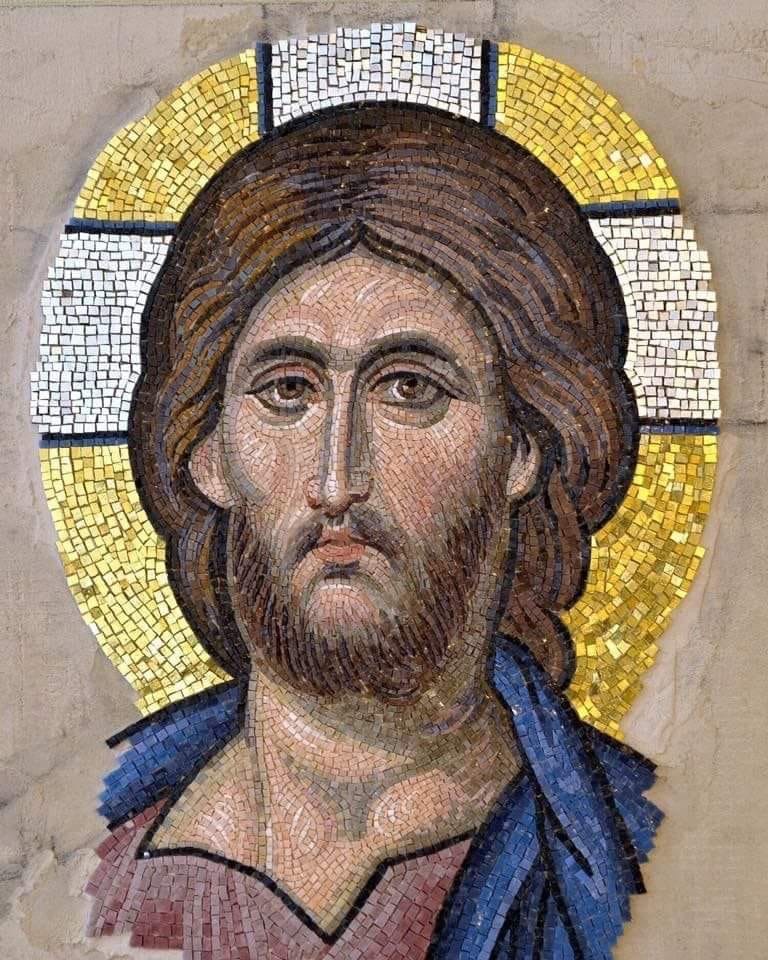
Showing posts with label Lord's Prayer. Show all posts

Thursday, November 13, 2025

Praying the Lord’s Prayer with the Saints

The Lord’s Prayer is not merely a set of words to be recited, but a divine pattern for all prayer. Saint Gregory of Nyssa and Saint Ignatius Brianchaninov help us uncover its inner meaning—showing that through this prayer, we are called to purification, union with God, and the transformation of our hearts.

The Lord instructed His disciples, saying:

When you pray, go into your room, close the door, and pray to your Father, who is unseen. Then your Father, who sees what is done in secret, will reward you…

And when you pray, do not keep on babbling like pagans, for they think they will be heard because of their many words.  

Do not be like them, for your Father knows what you need before you ask Him.

This, then, is how you should pray: Our Father…

(Matthew 6:6-9)

Christ teaches us to avoid the vain and thoughtless speech—the “babbling” that arises from distraction and self-importance. True prayer begins with stillness: we must quiet our thoughts, turn inward, and focus our mind on God. We come before Him as His creatures, fashioned from the dust of the earth and wounded by the Fall of Adam and Eve. This remembrance of our lowliness is the beginning of humility, and humility is the foundation of all genuine prayer.

Our Father, Who Art in Heaven

The Lord’s prayer begins with a profound declaration: “Our Father.” In these words, we are invited into an intimate relationship with God—not as distant servants, but as His children. To call God “Father” means that we recognize ourselves as sons and daughters who bear His image and are called to grow into His likeness. Yet this is also a daring confession, for how can we, fallen and unworthy, claim such kinship?

Saint Gregory of Nyssa observes that Christ gave this prayer before His work of redemption had been completed, and yet already called his followers to address God as “Father.” This reveals the depth of His mercy: He offers even sinners the privilege of sonship, inviting us to repentance and purification so that we may truly live as His children. Before we utter these words, we should therefore examine our hearts and ask whether we are striving to live in a way that befits those who bear His name.

When we add the phrase “Who Art in Heaven,” we are reminded that our Father is not of this world. To pray properly, we must lift ourselves above earthly cares and direct our hearts towards a heavenly homeland prepared for us. Prayer begins with an ascent: a rising of the soul toward God, who awaits our return in the kingdom of Heaven.

Hallowed Be Thy Name

To hallow God’s name means to make it holy—not that His name itself can become more holy, and manifest its holiness through our lives. When we pray, “Hallowed be Thy Name,” we are asking that God’s holiness be revealed in us—that our thoughts, words, and deeds may glorify Him. This petition calls us to purification, repentance, and the struggle against sin, so that God’s light may shine through us without stain or shadow.

Saint Gregory of Nyssa explains this beautifully:

God’s name should be glorified through my life—a life purged from all stain of sin… a life that will oppose fortitude to the assaults of the passions…a life not softened by the luxuries of the body… not engulfed by the pleasurable enjoyments of its life… a life that strives after the immaterial life and divine.

Thus, the holiness of God’s name is not honored merely by our speech but by our way of life. Each time we pray these words, we renew our commitment to live as true children of our heavenly Father—so that His name may be sanctified in us, and through us, in the world.

Thy Kingdom Come

When we pray, “Thy Kingdom Come,” we are not merely asking for the end of time or the final coming of Christ in glory. We are asking that His divine reign begin within our hearts even now. As Saint Ignatius Brianchaninov reminds us, the Lord has said, “The kingdom of God is within you” (Luke 17:21). Therefore, this petition is a plea that God’s grace may rule within us—subduing the tyranny of sin and transforming our inner life into a dwelling place for the Holy Trinity.

To desire the coming of the Kingdom is to long for union with God. Christ Himself says, “If anyone loves Me, he will keep My word, and My Father will love him, and We will come to him and make Our home with him” (John 14:23). This is what we are asking for when we pray these words: that God’s Kingdom may descend into the depths of our being, so that His will, His peace, and His love may reign in us.

Saint Gregory of Nyssa explains:

 “When we ask that the kingdom of God may come to us, we mean we desire to be freed from corruption and death; when the Kingdom of God truly comes, all earthly sorrow and suffering will vanish, and joy will reign forever in the soul.”

Saint Ignatius adds: 

“A person who feels the kingdom of God within him becomes a stranger to the world that is hostile to God.”

To pray for the Kingdom, then, is to ask that our heart become heaven—that our mind be illumined, our will purified, and our desires conformed to the eternal joy of God’s presence. We are seeking to live already, even on earth, as citizens of that heavenly realm.

Thy Will Be Done on Earth as It Is in Heaven

When we pray, “Thy will be done,” we are surrendering our own self-will and asking that our life may be governed entirely by God’s divine purpose. This is not an act of resignation, but of trust and love. Just as the angels in heaven obey God’s will perfectly, we are asking that His will may also be fulfilled perfectly in us on earth.

Saint Ignatius Brianchaninov teaches:

“Only through the will of God can the human will poisoned by sin be healed.”

The submission of our will to God’s will is the most perfect and saving path. This healing requires His grace. Left to ourselves, our will is enslaved by passions and distorted desires. To say “Thy will be done” is to ask God to restore harmony to our soul—to cure the sickness within that drives us away from Him.

Saint Gregory of Nyssa writes:

“When Thy will is done in me, every corrupt and wicked movement of my free will is brought to nothing.” 

Our uncontrolled passions will be subdued; our pride will be destroyed by humility; our charitable acts will expel many evils that live in our soul; hate, envy, and anger will be controlled; any hypocrisy or cravings for revenge will be eliminated.

Through this prayer, we ask to be made whole—to have our heart purified, our pride humbled, and our will aligned with the divine will, until our life mirrors the obedience and peace of the heavenly hosts. Then, even amid the struggles of this world, our soul begins to live in the harmony of heaven.

Give Us This Day Our Daily Bread

This petition has both an earthly and a spiritual meaning. On one level, it is a humble request for what is necessary to sustain our bodily life. On a deeper level, it points to the divine nourishment of our soul—the heavenly Bread that is Christ Himself.

Saint Ignatius teaches that his daily bread is first of all the life-giving food we receive in the sacrament of Holy Communion, where we receive the true Body and Blood of Christ. Through it, our mortal nature is united with His immortal life:

This bread is not perishable. It transforms us into His likeness and will give us everlasting life. Jesus says, “He who eats My flesh and drinks My Blood abides in Me and I in him…whoever feeds on this bread will live forever.” (Jn 6:56). Thus, when we pray for our “daily bread,” we are asking that we may be made worthy to receive Holy Communion—not casually or unworthily, but as those who hunger for eternal life.

Yet Saint Gregory of Nyssa also reminds us that this prayer also includes our simple bodily needs. Christ, who took flesh and shared our hunger, teaches us to depend upon the Father each day and to seek nothing beyond what is necessary. Gregory writes:

“Ask for this bread—not delicacies or riches, nor magnificent garments, golden ornaments, precious stones…,or landed estates, military commands, or political leadership.” 

Ask for the food which sustains life.  We are saying that we must trust in Him that He will provide what is necessary for this day.

This petition, then, trains the heart in trust and moderation. We ask for what is needful, not for excess. We entrust ourselves to the daily providence of God, knowing that all who seek first His Kingdom will lack nothing essential. Whether in the Eucharist or in the simple bread of daily life, He is the One who feeds and sustains us.

Forgive Us our Trespasses

In this petition, we ask for God’s mercy—and at the same time, we commit ourselves to show mercy toward others. Forgiveness is not optional for the Christian; it is the condition of our own forgiveness. Christ Himself makes this clear:

For if you forgive men their trespasses, your Heavenly Father will also forgive you. But if you do not forgive men their trespasses, neither will your Father forgive your trespasses” (Matt 6:14-15)

When we pray these words, we acknowledge that we are trespassers before God. There is no one that is righteous in the eyes of God (Romans 3:10). The measure of mercy we extend to others becomes the measure by which we ourselves are judged. When we approach God in our prayer, we recognize God as the Benefactor. Therefore, we too need to be benefactors to call Him our Father.

Saint Gregory of Nyssa says, 

“Do you want your trespasses to be forgiven by God? Forgive then yourself, and God will ratify it. For your judgment of your neighbor, which is in your power whatever it may be, will call forth the corresponding sentence upon you. What you decide for yourself will be confirmed by Divine judgment.”

When we forgive, we make room for grace. Our heart becomes light, and prayer becomes pure. Thus, in saying these words, we are not merely asking for pardon—we are learning to love as God loves, and to be freed from the burden of vengeance and pride.

Lead Us Not Into Temptation

In this final petition, we acknowledge our weakness and ask for God’s protection. Temptations arise both from the enemy and from the passions that dwell within us. We cannot overcome them by our own strength; we need divine help to resist the snares that lead us away from God.

When we pray, “Lead us not into temptation,” we are not suggesting that God tempts us to sin—for Scripture declares, “God cannot be tempted by evil, nor does He tempt anyone” (James 1:13). Rather, we ask that He would not permit us to fall into the power of temptation, that we might not be overwhelmed by trials beyond our strength. We pray that our hearts may remain steadfast, guarded by His grace.

Saint Ignatius writes:

Do not allow us to be carried away by our sinful desires.

Do not allow us to be conquered by love of money, ambition, or lust for power.

Do not allow us to be misled by false thoughts and teachings.

Do not allow us to become enslaved by sensuality or gluttony at times when we abound in earthly good things, or by pusillanimity and grumbling when we are surrounded by depravations.

Do not allow us to be seized by pride when we are leading a virtuous life, or swallowed up by hopelessness and despair in the face of stumbling blocks.

These words reveal the depth of the struggle. Every passion, every thought, every trial can become a temptation if it turns us from humility and trust in God. Yet even these struggles, when endured with faith, can become occasions of victory, as the Apostle says,

“Through many tribulations we must enter the kingdom of God”(Acts 14:22).

When we add, “but deliver us from evil,” we are asking for freedom from the dominion of the evil one—the adversary who seeks to destroy the image of God in us. Only Christ can deliver us from his power. Through this prayer, we entrust our whole life to the mercy and might of God, that we may be preserved in the light and peace of His Kingdom.

Thine Is the Kingdom, and the Power, and the Glory

We conclude this prayer saying: 

“For Thine is the kingdom and the power and the glory forever. Amen.”
 The Lord’s Prayer ends with praise—a doxology that returns everything to God. Having asked for our needs, forgiveness, and protection, we now confess that all good belongs to Him: the Kingdom, the Power, and the Glory. In this way, the prayer closes where it began—with the acknowledgment that God alone is our Father and King, the source and goal of all things.

Saint Gregory of Nyssa and Saint Ignatius Brianchaninov remind us that in praying the Lord’s Prayer, we are asking for nothing less than God Himself—to dwell in us, to establish His Kingdom within us, and to make us sharers of His divine life. Every petition leads toward this one end: union with God in love.


Saint Ignatius Brianchaninov says,

“We are asking God to do no less than grant us Himself, to dwell in us and establish His kingdom within us, so that we, through this, may reside in Him, and reign through Him 5overall”.

This is not the only prayer we should be offering. In our other prayers, we should be asking for only things needed for our spiritual growth and to purify our souls so we can live in Him eternally and He in us. 

Saint Ignatius warns: 

Beware of asking for earthly good things and privileges that fill the prayers of heathens.”

Our prayer, then, must always aim toward the eternal: the sanctification of our lives, the indwelling of the Holy Spirit, and the fulfillment of the divine will in us. As Christ Himself teaches, “Seek first the Kingdom of God and His righteousness, and all these things shall be added unto you” (Matthew 6:33).

To pray the Lord’s Prayer with understanding is to walk the path of transformation. Each phrase becomes a step in our ascent—from humility, to purification, to illumination, and finally to communion with the living God. When we pray with attention and repentance, the words of the Lord become the living breath of our soul. Through them, we learn to live already in the peace of His Kingdom—here and now, and unto the ages of ages.

Let us pray the Lord’s Prayer not merely with our lips, but with a heart striving to live its meaning—until every word becomes reality within us.

References: 

St Gregory of Nyssa, The Lords Prayer, The Beatitudes, Ancient Christain Writers No 18

St Brianchaninov, The Harvest, vol IV, The Collected Works


Friday, October 4, 2019

Understanding the Lord’s Prayer (8): Lead us not into temptation but deliver us from evil


This is a petition to not be overcome when we are faced with temptations. James told us that God does not temp us (James 1:13). Saint Paul tells us to not allow us to be tried by the devil  “beyond our capacity, but with the trial also provide a way out, so that we may be able to endure.” (1Cor 10:13)

We are asking Him to free us from our attachments of this world. Free us from our passions and desires,  Saint John tells us “the whole world is in the power of the Evil One" (I jn 5:19). We need to be led by God to move away from everything that causes us difficulty in doing only His will.

Saint Gregory of Nyssa puts it this way,
But let us stand and say to God: "Lead us not into temptation," that is, into the evils of daily life, but deliver us from the Evil One" who possesses power over this world. May we then be delivered from the evil one by the grace of Christ, to whom belongs the power and the glory, together with the Father and the Holy Spirit, now and forever, and to the ages of ages.

Monday, September 30, 2019

Understanding the Lord’s Prayer (7): Forgive Us Our Trespasses As We Forgive Those Who Trespass Against Us


We ask for this because we have the tendency to sin. Even though we have been baptized we still can sin. We need His forgiveness . But The Lord made this request conditional. If we expect God to forgive us we must be willing to forgive others. So we are only asking to be forgiven as we are able to forgive others.

Jesus told us 
For if ye forgive men their trespasses, your heavenly Father also will forgive you. But if you do not forgive  men their trespasses, neither will your Father forgive your trespasses." [Matt. 6:14-15]
Jesus also tells us that “whoever is angry with his brother without good cause shall be liable for judgment” Mat 5:22.

Jesus gives us this message again in the parable of the unforgiving servant (Mat 18:23-35). It’s very clear that our failure to forgive others is to willfully alienate ourselves from God.

Our petition for mercy is contingent on the mercy we are able to show others. Here we are not asking for any more than what He has told us He is willing to give. We can also think that this request means to help us in our ability to forgive those who trespass against us. We need this help to receive the full mercy of God.

Saint John Cassian writes
Whoever, then, does not from his heart forgive the brother who has offended him, will, by this entreaty, be asking not for pardon but for condemnation for himself, and by his own say-so he will be requesting a harsher judgment for himself when he says: Forgive me as I also have forgiven....If we wish to be judged mercifully, we must ourselves be merciful towards those who have offended us. For we shall be forgiven to the degree that we have forgiven those who have injured us by any wrongdoing whatsoever.9th Conference p344
We are asking to become like God who is all merciful, ever ready to forgive us. We want to imitate Him and follow how He taught His disciples.

Saint Cyril says,
He requires, therefore, His disciples to be gentle (2 Tim. 2: 24) and slow to anger (Jam. 1: 9), so that they may be able to say blamelessly in their prayers, "Forgive us our sins: for we also forgive everyone that is indebted unto us."
God’s mercy is given to all those who are humble. It is given to those who accept God as their Lord, who seek to do .his will, and who search in themselves all the ways they fail to live up to His commandments. The know themselves. But, they are not arrogant thinking themselves superior to others, standing ready to condem others for their sinfulness or refusinfpg to forgive those who have trespassed against them.

Saint Cyril,
For God readily accepts, and has mercy on those who do not forget their offenses, but fall down before Him, and ask of Him forgiveness: but He is severe, and very justly so, upon the stubborn and the proud, and on him who in his great ignorance acquits himself of blame. For He said to one thus disposed, "Behold, I have a suit against you, because you say, I have not sinned" (Jer. 2: 35).
The road then to salvation, and which delivers those who earnestly walk thereon from the wrath of God, is the confession of offenses, and to say in our prayers to Him Who purifies the wicked, "Forgive us our sins."

In addition we can not forget the judgement of God. Those who acknowledge their sins and are merciful to others we be shown mercy at the time of judgment. If we are not willing to face all the ways we miss the mark, and satisfied to continue in our sinful ways, are not worth of His kingdom. Such a person can’t recite this petition..

Saint Cyril,
it is not fitting for those who still continue in wickedness, and wish to do so to the last, to say, "Forgive us our sins," but for those, rather, who have abandoned their former wicked deeds, and now earnestly desire to live fitting of saints.....this is fitting only for those to say, who have chosen a virtuous life, and are practicing without remissness that will of God, which, as Scripture says, is "good and acceptable and perfect" (Rom. 12: 2).....
by thus forgiving the brethren what they do to us, we shall then certainly find Christ, the Savior of all, gentle and ready to show us mercy:

Friday, September 27, 2019

Understanding the Lord’s Prayer (6): Give Us This Day Our Daily Bread


When we ask the tho Lord for daily bread we are asking for the necessities for a spiritual life. The Greek word for the kind of bread is “επιουσιον” which implies more than simple bread but that which is necessary to sanctify, it is literally “above the essence” or “supersubstantial.”

The Orthodox Study Bible gives us this explanation.
The expression daily bread indicates not merely bread for this day, taken for sustenance of life; it is bread for the eternal day of the Kingdom of God, for sustenance of our immortal life. It is living, “superessential” bread. This bread prepared by God in the beginning of immortality of our nature, is the Bread of Life which will triumph over death brought about by sin.
We earlier have asked that His kingdom come. Jesus commands us to seek first the Kingdom of God Mat 6:33. Now we are asking for more than physical bread for our physical health, for spiritual bread which gives us eternal life. This can be see as the Living Bread, Christ Himself, that we receive in the sacrament of Holy Communion 

Saint Gregory of Nyssa interprets this as what is necessary for “moderate conduct.” He says it is “being content with little by being free from evil passions, on the same plane as the angelic attribute of lacking nothing.”

He says further,
Your obligation to human nature is only a small thing. To your flesh you owe food, a modest and easily accessible thing, if your purpose is to meet only a need, ask for bread to meet life's needs. You are obligated by nature to the body only in this regard. Bread is for our needs today. The Kingdom is for our blessedness in the future.

Saint Cyril of Alexandria says,
Let us ask of Him what suffices for life — food, that is to say, and clothing, and whatever is sufficient for us -avoiding all wish to be rich, as that which threatens us with destruction. For if this is our will, Christ will accept and bless us;
The idea of daily shows us that our spiritual needs are needed every day. The spiritual life is ongoing day by day. It is not attainable in a single day but necessary every day.

Saint Cassian says,
It warns us that we should pour out this prayer constantly, because there is no day on which it is not necessary for us to strengthen the heart of our inner man by eating this.9th Conference p 343
Saint John Chrysostom says that it says daily so we will not worry about tomorrow. 

Saint Theophylact says,
By the word daily He means what is sufficient for our essence, and our sustenance. He teaches us not to worry about tomorrow. Bread for our essence is also the Body of Christ, of Which we pray we may partake without condemnation.Theophylact on Matthew p 58

Monday, September 23, 2019

Understanding the Lord’s Prayer (5): Thy will be done on earth as it is in heaven


Based on what we have understood from what precedes this this petition is quite clear. He wants us to become like our Father, to be with him in His kingdom. To do so we ask that we be able to do what He wills for us, to be like the angels in heaven.
Saint Cassian writes,
Human beings should be like angels and that, just as God’s will is fulfilled by them in heaven, so also all those who are on earth should do not their own will but His will.P 342
Saint Cyril says,
We supplicate, that power may be given to the dwellers upon earth to do the will of God, and imitate the conduct practiced above in heaven by the holy angels. 
Saint Theophylact reminds us that we are asking to be as obedient as the angels. He says,
Just as the angels do Thy will, the Lord says, also grant us to do the same.
Theophylact on Matthew p 58

What is necessary for us to be able to do this? What kind of help are we asking for? First, we need His help to know ourselves more deeply, to help us see what we do that is not according to His will. Then we want to have the strength to condemn this aspect of our life and to make changes, to overcome old habits and establish new ones that conform to His will.

Gregory of Nyssa says,
To say to God, "Thy Will be done also in me," it is entirely necessary first to condemn that manner of conduct which is lived outside the divine will and to fully own up to it in confession.
Saint John Chrysostom tells us that we are to make our life here on earth as in heaven, he says,
He hath bidden us make the earth a heaven and do and say all things, even while we are continuing in it, as having our conversation there; insomuch that these too should be objects of our prayer to the Lord. 

Saint Cyril writes
Those, therefore, who in their prayers ask that the will of God may be done also on earth, should "cleanse [them] selves from every defilement," leap out of the pitfalls of iniquity, and make "perfecting holiness in the fear of God" (2 Cor. 7: 1), that as Paul also says, even while walking upon earth, their citizenship may be in heaven (cf. Phil. 3: 20).
....
Therefore, the will of God which we pray may be done upon earth, is not that we should conform to the law, and live according to the grossness of its letter, but that we should endeavor to live by the gospel. And this is effected by a faith correct and free from error, and by a holy life, possessed of the sweet savor of every virtue, and proved by the testimony of good and noble conduct in every thing that is excellent.

Friday, September 20, 2019

Understanding the Lord’s Prayer (4): Thy Kingdom Come

Thy kingdom come.
When we ask for His kingdom to come we are showing our eagerness for our unity with our father and the desire to be with Him eternally in His kingdom. We are desirous now for what Christ has promised. “Come, blessed of my father, take possession of the kingdom prepared for you from the foundation of the world.” Mt 25:34

Asking for His kingdom to come we are acknowledging God as an all powerful ruler of creation, one who reigns over all. That His kingdom is eternal. 

We pray that we be granted a life that we can see in holy persons. We are asking for a daily life that is united with our Father in heaven with the purity of heart, freed from passions, with His grace enabling us to do His will. In this way we will have a life in His kingdom.

Gregory of Nyssa says,
We pray "Let Your Kingdom come upon us" in order that the evil passions which rule and lord it over us may depart from us, and indeed vanish into nothingness.
Saint Gregory also reminds us of the way Saint Luke expressed this. He told us that he who prays for the coming of the Kingdom is calling on the Holy Spirit. Luke writes instead of "Thy Kingdom come," it is written, "Thy Holy Spirit come upon us and cleanse us."

Gregory of Nyssa,
Truly, let the Holy Spirit come upon us and cleanse us. May He make us receptive of noble thoughts worthy of God. Such thoughts are taught to us by the Lord's Prayer coming from the voice of the Savior, to whom belongs the glory forever and ever. 
Saint Theophylact suggests that this refers to the second coming, this is also the view of Saint Cyril of Alexandria.
He says,
To desire to behold Christ the Savior of all rising again upon the world. For He will come, He will come and descend as Judge, no longer in low estate like unto us, nor in the simplicity of human nature; but in glory such as befitting of God, for He dwells in unapproachable light (cf. 1 Tim. 6: 16),
Since this seems like a frightening time why would He want us to pray that this time of judgment come now? He asks us to do this so we can be prepared and motivated to live a life that will yield for us favorable judgement.

Saint Cyril says,
For He commanded them to ask in prayer that this fearful time may come, to make them know that they must live, not carelessly, nor dissolutely, nor moreover as beguiled into laxity and the love of pleasure; but, on the contrary, as becomes saints, and according to God's will: that so that this fearful time may prove the bestower upon them of crowns, and not of fire and condemnation. For it was not at all proper for the wicked and impure, who lead base and lascivious lives, guilty of every vice, in their prayers to say, "Thy kingdom come."
At the second coming we will be resurrected and become a new creation, reunited with our bodies in a life eternal where there is no suffering or death. This is what we hope for. All this is what is part of asking for His kingdom to come. We are asking to be accepted, to be purified, to be rid of sin and passions so we will be in His eternal kingdom.


References: On the Lord's Prayer Homilies on the Lord's Prayer by St. Cyril of Alexandria Coptic Orthodox Diocese of Los Angeles, Southern California, and Hawaii Saint Paul Brotherhood, Saint Theophylact’s commentary on the Gospel of Matthew, Saint Gregory of Nyssa discourse on the Lord’s Prayer.