Showing posts with label Christmas. Show all posts

Saturday, December 6, 2025

Beyond the Manger: Christmas Is the Birth of a New Humanity


In this season, when we are scurrying about to buy presents and celebrate with friends, co-workers, and family, we should pause and ask ourselves: What are we celebrating?

Supposedly, it is about a newborn baby whom Christians claim to be God in human flesh. But is this merely God “appearing” in the world? Is it simply the beginning of Christ’s sacrificial work?

No! It’s much more.

Christmas is the beginning of a new humanity. In the birth of this Child from a virgin mother, God’s divine nature is united with human nature, and the divine energies of God permeate the very depths of what it means to be human.

For a very long time, humanity struggled to follow God’s teachings. He gave us a Law. He sent prophets. Yet more was needed to fulfill the divine plan.

In Paradise, Adam and Eve were created in God’s image and were challenged to use their free will in obedience to His will. They were tempted and failed. Their choice brought about a voluntary separation from the divine union they had enjoyed. To complete His plan for them, God sent them out of Paradise, clothed them in “skins”—a mortal, physical life destined to die. And over many generations it became clear that humanity could not overcome this wounded condition on its own. Something more was required for healing and for the full development of what it means to bear God’s image.

What was needed was an inner change, a restoration of union with God so that divine energy could once again flow through the human heart—giving the power to overcome the passions inherited in this mortal life. Without this healing, mankind remained separated from its Creator.

Sin could not be overcome by human effort alone. Pride infected humanity, and the more people tried to save themselves, the more prideful they became—placing themselves at the center of creation. They could not reach out in humility to embrace the love of their Creator.

This is where the significance of the Incarnation comes into play.

The Incarnation of the Son of God, Jesus Christ, was not simply a way to pay a debt, nor merely a lesson in virtue. He came to transform human nature itself. Humanity needed an inner healing. By uniting divine and human natures in His miraculous birth, Christ opened the path for all mankind to receive divine energy, to gain the power needed to tame the passions of our fallen nature, and to grow into the likeness of God—into the likeness of Christ Himself.

Today, because of this transforming event, all people can be united with Christ through:

  • a rebirth in Baptism,
  • the receiving of the Holy Spirit into the heart,
  • partaking of His Body and Blood in Holy Communion,
  • a life guided by clergy ordained by Him,
  • discipleship and cooperation with His Spirit,
  • and membership in His Body, the Church, the gathering of the faithful.

This is what we are truly supposed to be celebrating in this season.

It has nothing to do with gift-giving, Santa Claus, or the endless consumerism that fills these weeks with noise and distraction.

Let us reflect instead on this great event—how we have been blessed by this transformation, how we are empowered by the Holy Spirit to be reunited with Christ, and how, through cooperation with His divine energies, He now lives within us, preparing us for eternal life with Him and a return to Paradise.


Monday, December 18, 2023

The Divine Incarnation: Understanding Christmas Beyond Bethlehem


As we celebrate Christmas, it's essential to delve deeper than the traditional imagery of Bethlehem, a guiding star, a humble birth in a manger, angels glorifying, and the arrival of the wise men. These elements, while important, especially for children, only scratch the surface of a profound spiritual truth for adults.

The Birth of Jesus Christ: A New Creation

The birth of Jesus Christ marks not just a historical event but a miraculous new beginning. Jesus's conception itself was extraordinary, born not of earthly means but through the Holy Spirit's action upon Mary, a most holy woman. This miraculous event allowed the divine to become joined with humanity, creating a unique union of God in human flesh. Jesus, thus, stands as the 'New Adam', symbolizing a new possibility for humanity.

Theosis: Becoming United with God

The Incarnation opens the pathway to Theosis – an intimate union with God. In the Orthodox Church, through Baptism and Chrismation, we receive the Holy Spirit which is panted in our hearts, echoing this divine union. As Scripture affirms, God then lives in us and we live in Him and we become adopted children and heirs. As St. Symeon the New Theologian expressed, our rebirth in Christ transforms us, allowing us to don divinity and become heavenly as Christ is heavenly.

If you are a Christian inasmuch as Christ is heavenly, so also you should be heavenly…He made the whole of me God. He assumed my condemned flesh, and dressed me in full divinity, for having been baptized I put on Christ (Gal 3:27) not perceptibly, but by all means mentally. (Hymns of Divine Love, Hymn 44)

Without the Incarnation, this union with God would remain unreachable, leaving us in our fallen state stemming from Adam and Eve's fall. However, Jesus's life and teachings show us the path to this new creation, to become divine like Him and return to our state before the Fall due to Adam and Eve's disobedience. We can now put on Christ, not physically but spiritually. Through grace, adoption, perception, knowledge and contemplation we are transformed by following His example. We can now become like Him!

Embracing Spiritual Transformation

Christmas is more than a commemoration; it's an invitation to spiritual transformation. It's a journey that requires faith, following Christ's teachings, and living in obedience to His commandments. This path opens our souls to increasing grace, enabling us to experience God's presence and align our will with His.

Saint Symeon writes about the ultimate goal of God's incarnate word: to make us partake in His divine nature, to elevate us by grace to His level by nature, preparing us for eternal life His kingdom.

Saint Symeon writes: 

“What is the aim of the incarnate dispensation of God’s Word, preached in all the Holy Scriptures but which we, who read them, do not know? The only aim is that, having entered into what is our own, we should participate in what is His. The Son of God has become Son of Man in order to make us, men, sons of God, raising our race by grace to what He is Himself by nature, granting us birth from above through the grace of the Holy Spirit and leading us straightway to the kingdom of heaven, or rather, granting us this kingdom of heaven within us (Luke 17:21), in order that we should not merely be fed by the hope of entering it, but entering into full possession thereof should cry: our ‘life is hid with Christ in God’ (Col. 3:3).”  St. Symeon the New Theologian, “Practical and Theological Precepts” from The Philokalia

The True Gift of Christmas

Thus, the true gift of Christmas is the potential for Theosis, a profound transformation that transcends moral directives or societal norms. It's a metamorphosis of our very being, led by the Spirit and grace, to intimately know God and become like Him.

As we celebrate Christmas, let's remember and glorify: Christ is born! Humanity is transformed! We are invited to follow Him and become divine in His likeness.


Wednesday, December 18, 2019

Why did Jesus come?


For whom did He come? He came for each of us, for our salvation! Think about all He did only for our benefit. We must remember He was born of a Virgin, took human flesh becoming fully human. He was a child and was raised on His mother’s milk. Even though He was from before time, He came in total humility, wrapped in swaddling clothes, born in a smelly stable. As John says, “And the Word was made flesh (Jn 1:14).” Then, when still a small child, He fled from the terror of Herod who wanted to kill Him. Remember when he began teaching how He went from place to place, helping others to awaken to their salvation, without giving concern about His own worldly desires. He was blasphemed, cursed and mocked. He was tortured, suffered, and even betrayed by one of His disciples. Finally, He was led to his death to be hung on a Cross between two lawless evil doers. Why did He do all this? He did it only for our benefit, our salvation. Remember these things.

Many of us have ignored Him and have lived a life for our pleasure. Remember his Blood he shed, all His suffering, all He did without regard for Himself. Think about His extreme humility. All He asks is that we be uplifted by His example and accept His love. All we need to do is to humble ourselves and repent.

Saint Tikhon writes,
Christ the son of God shows us His coming into the world for his sake in the Gospel. He presents in him His willing self-emptying, His willing poverty, His willing and deep humility, His labors, pains, tribulations, sorrows, sufferings and death, and even a death on the Cross. And He says to us, “I took all this on myself and endured it for your sake and for your salvation. But you neglect your salvation, and take no thought that you should repent and cease from your sins, to make use of My Blood and live.” 
Why do we languish in our sinful way of life and make no effort to change when God Himself has come out of love for us to show us the path to be saved? Why do we not understand that He came to help us, not punish us? If we do not heed his word there will be a judgement and we will not find eternal joy, but will be eternally separated from the source of love. We need to awaken to the Truth.

Saint Tikhon says,
Set your salvation on nothing else but on Christ Jesus alone, the Savior of the world. If you truly believe that He suffered and died for you and is your Savior, then love Him as your Savior, and lay and confirm all your hope in Him alone.
His Church was created when He sent the Holy Spirit to empower His disciples. He gave them instruction and guidance on how to nurture our fallen souls so all of us could be united with Him. They created what can be thought of as a spiritual hospital, with Sacraments, beautiful liturgies that lift us to heaven, with guidelines for ascesis like fasting and rules for daily prayer. When we awake we will rush to the Church ahead of time seeking to be renewed and nourished by His Body and Blood in the sacrament. We will make time for daily prayer and read daily Scripture and the writings of the Church Fathers,

Remember how He came, how He selflessly gave Himself for our benefit. Make a renewed effort to follow Him and prepare yourself to be worthy of His grace.

Reference: Journey to Heaven, by Saint Tikhon of Zadonsk, pp 41-44

Thursday, December 5, 2019

Christmas Is What We Make It - Understanding the icon of the Incarnation (Nativity)


Awake! God is becoming man. He wants to show us the path to paradise.

When I look around me the signs of this season to not point to such a great event. The images that I found with a google search are mainly about Santa Clause, reindeer, Elves, presents, decorated trees, office parties... Seems like the season is all about this world’s pleasures. Where is Christ? What kind of Christmas will WE make?

To tell the truth, it seems like most us us are asleep spiritually. We enjoy Christmas time with all its celebrations. But in the midst of these God is distant from us, we are unaware of our sinfulness, we rarely pray, only attend church periodically out of duty, and only periodically participate in the sacrament when we do come, and many have never been to confession. Maybe the secular Christmas celebration fits us. Are we are making Christmas fit what we believe?

We all need to be awakened to the Truth!

What is Christmas all about? Are we celebrating the birth of a baby boy? No! We are celebrating the beginning of the way to our salvation. God becomes man, a human being who is also God! Christmas is about the Incarnation of our Lord, Savior, our Creator. God becomes man to show us our true potential created in His image and likeness. After His birth He lives with humility, heals, teaches and then is unjustly and voluntarily killed by Crucifixion, suffers, is  beaten, humiliated, and hung naked nailed to the Cross. His life and death was to show us our path to paradise. After His death He is resurrected, defeating death with His death. He then Ascends into Heaven and is seated at right hand of God. After teaching His disciples the mysteries sends the Holy Spirit empowering them to establish ecclesias, gatherings of believers, communities where they can grow spiritually. This all begins with the event we call Christmas. We are celebrating our very entrance into the pathway of our salvation.

The festival approacheth, the most to be revered, the most awesome, and which we might justly term the centre of all festivals,—that of the birth and manifestation of Christ in the flesh.
Saint John Chrysostom 

Let’s not be lulled to sleep with all the secular attachments that merchants have created to stimulate our shopping habits and desires. Our secular values have stripped the true meaning from all aspects of the activirties of this season.

How was Christmas celebrated traditionally?
It began with a fast, an inner period of reflection, preparing ourselves to become more worthy to receive the King. It was only after the Christmas Day that we celebrated, exchanged gifts, visited friends and relatives. This is the 12 days of Christmas which are fast free and set aside for celebration of this great event. Before this awesome day we are preparing to receive God as man and then, after His birth, to glorify His coming for our salvation. The celebration ends with another important celebration, Epiphany, the baptism of Christ and the beginning of His ministry.

Nativity Icon
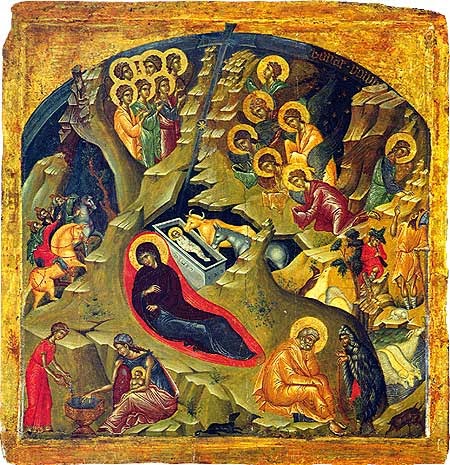
To better understand this most significant event in the history of mankind let’s examine the icon that tells the story of the Incarnation. Not just the birth of Jesus the man, but the Incarnation of God! Looking at the icon it appears as a scene beyond time. The immediate focus is Mary, calling us to better understand her role. The scene is totally different than that portrayed in most western nativity scenes. Let’s explore it. It tells the entire story in one image.

There are eight parts to this icon: the birth place, the star, the mother of God—the Theotokos, Christ, Joseph and the devil, the Angels, shepherds, wise men,  and the midwives.

Let’s look at each of these in detail.


Christ:  
He is wrapped is swaddling cloths which is how a person was normally wrapped after birth. The infant was wrapped in a cloth that was four to five inches wide and five to six yards long. He would be wrapped like this for seven days and then cleansed and rewrapped, a process that lasted fourth days. They believed at that time that this would help the soft bones of the child grow straight. It is also similar to how a person is wrapped for burial after death. This symbolizes the destiny He faces like all of us, so He can show us the way to life beyond death. In HIs Resurrection He will show us how we too can claim victory over death with faith and following Him.
St Ephram the Syrian writes: His swaddling clothes gave a robe of glory to human beings.
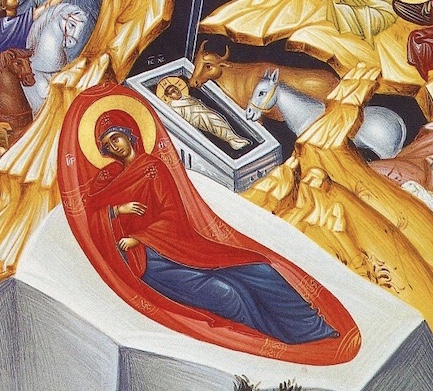
Notice how the manger is not a traditional food trough for animals but appears as a tomb. This is intended to remind us that Christ came into the world to die for us and then show us victory over death in the Resurrection. 
The animals are an Ox and a donkey. This comes from a prophesy in the Old Testament in book of Isaiah: “The ox knows his owner, and the donkey his masters crib (Isaiah 1:3). They are show providing warmth to Jesus by their breath.

Birth place:  
The birth of God took place in dark cave shown in the center of the icon. When Mary and Joseph arrived in Bethlehem to pay their taxes they found no room in traditional lodging places. By God’s providence they found shelter in cave. In the area of Bethlehem caves were often used as places to shelter the animals. The cave also is a symbol of the coming of God as a human being to bring light into the darkness of our souls, our ignorance of our sinful condition, and to give light to the way out of darkness to eternal paradise. The fact that it was also a stable, also has important symbolism. You can see the animals looking at the Christ child. Where animals were kept was a smelly place, not a desirable place to stay, let alone give birth to a child, but this place was not chosen by chance because it shows the humility of Christ. He could have chosen to be born in a palace, but He was coming to show us that the way to paradise is based on humility. He is showing us that this needs to be an important value in our lives, to not seek riches or honors, or to be seen as better than others. 
“The Good Shepherd, He who lays down His life for His sheep, came to seek that which had strayed...He humbles Himself, that He may raise up with Himself the soul that was tottering to a fall under a weight of sin....[for] my perfection and return to the first condition of Adam.” Saint Gregory the Theologian, oration 38
The dark background in the cave can be explained by the birth of Christ being like the spiritual light that shines forth in the shadow of death that surrounds all mankind. The black mouth of the cave symbolizes the world filled with sin from the Fall of mankind, and with the the birth of the Savior, the “Son of righteousness,” it is now enlightened with a clear path to return to paradise.

Mary, The Theotokos:  
Notice how she is in the middle and focal point of the icon. Without her there would not be the Incarnation. All that follows would not have happened. She was especially prepared by God to be pure so she could give flesh to the Son of God. She is looking away to show her humility. This was a miraculous birth by a virgin through the work of the Holy Spirit.
“When God became known to us in the flesh, He neither received the passions of human nature, nor did the Virgin Mary suffer pain, nor was the Holy Spirit diminished in any way, nor was the power of the Most High set aside in any manner, and all this was because all was accomplished by the Holy Spirit. Thus the power of the Most High was not abased, and the child was born with no damage whatsoever to the mother’s virginity.” - St. Gregory of Nyssa

The Star:  
In the top center you can see a blue light which represents the star. This is the star that appeared in the East at the time of the Annunciation and led the wise men to Christ for about nine months. This was not a real star but the work of the Holy Spirit to show the way to Christ. It behaved differently than anything scientists have ever observed. It moved, it stopped, it ascended and descended, it changed direction. Some say it was Archangel Gabriel. Notice how it points directly to the Christ Child. Saint John Chrysostom says, “no natural star could have traversed such a course, nor could I have shone so brilliantly at midday; and, furthermore, it stood still over the Child.
In the icon it points directly to the cave. It is a long ray which connects part of a sphere that goes beyond the limits of the icon. This is a representation of the heavenly realm, signifying that the star and this ray are a messenger from the world on high.
 It brings our attention to Christ and indicates His divine nature.


Angels:  
Above Christ we can see a multitude of angels gathered to glorify the Incarnation. They have come also to herald the Good News of the birth of our Savior. This points out how this event is not just the birth of a child, but the Incarnation of God Himself. God has become man. Rejoice!


Shepherds:  
Even the shepherds came to glorify God. They were the first sons of Israel to come to worship the Christ Child. The shepherds watched over flocks of lambs destined for sacrificial services in this area where the birth took place. They are being told of the Incarnation by an angel. They were told: “ Be not afraid; for I bring you good news of a great joy which will come to all people; for to you is born this day in the city of David a Savior, Who is Christ the Lord. And this will be a sign for you: you will find a babe wrapped in swaddling cloths elating in a manger” (Lk 2:10-12).The shepherds heard the angels singing: “Glory to God n the highest, and on earth peace, goodwill among men.” (Lk 2:14)
Shepherds are simple people. Their presence indicates that God came for all people and not just those who are privileged. There is one shepherd playing a reed flute showing that music is appropriate for glorifying God.

Wise men or Magi:  
There are also three men on horses. One is a beardless youth, another middle aged and the third an old man They are referred to as Magi or wise men, member of a Persian class of  priestly scholars who were very powerful among the Persians. They were occupied with the study of medicine, philosophy, natural sciences and scientific study of the stars. They believed there was a mystical influence of the stars on earthly things so they were constantly studying the heavens for new signs. They were aware of the prophecies of Daniel, especially the one concerning the time of the coming of Christ. (Dan 9:25,26). They were also familiar with Barlaam’s prophecy about the star shining forth from Jacob (Num 24:17). When this unusual bright star appeared to them they knew it was a sign of a great event. Recognizing its significance they vowed to follow it to the scene of the Incarnation. They followed the star “till it came to rest over where the young Child was (Mat 2:11)” with His mother.  They brought with them gifts of gold, frankincense and myrrh, as a way of giving thanks to God. In the hymn for the forefeast we find the following :”The kings, first fruits of the nations, bring three gifts,...by myrrh they point to Thy death, by gold to Thy royal power, by frankincense to the dignity of Thy divinity.” Gold is also know as a symbol of wisdom, frankincense as power of prayer as it is burnt before God and myrrh the mortification of the body.
These men came some time after the actual birth, about two years later. This is a characteristic of icons. They capture what is necessary to tell the whole story.
This scene also tells us by their example that all scientific study is meant to lead us toward the true God.

Midwives: 
In the lower left we can seen the midwives preparing the bath water to bathe the new born child. This was done out of tradition as there was no blood in the birth. The bathing does not signify that Christ was unclean and in need of purification. This was done to show His true humanity. The two women are know as Zelomi and Salome. Salome is related to Mary. She is Mary’s mother’s sisters daughter, a first cousin. The duties of a midwife were washing the new born, rubbing it with salt, water and oil, and then wrapping it in swaddling bands.
This scene shows the full humanity of the Incarnate Son of God. Jesus was fully human in all regards except He was without sin. It is also symbolic of baptism which all members of His Church go through for spiritual cleansing of sins and a transformation with the Holy Spirit planted in their heart with Chrismation.


Joseph and the devil: 
In the lower right we have another scene with Joseph, an old man and another with a cane. Joseph is shown with a halo. He was an old man because he was of age when he was appointed to be the protector of Mary so she could live life as a virgin. He was probably 70-80 years old at this time. He is pondering this whole situation because he was not the biological father of the child. He is being tempted by the old man with the cane who is trying to raise doubts in his mind: How is it possible for a virgin to bear a child? This man is Satan, who is saying, “this is against all natural laws you fool!s!” The difficulty Joseph faced is no different from ourselves who have difficulty grasping the reality of the virgin birth and God becoming man while still retaining His divinity. The Incarnation of God goes beyond reason.
The tree you see to the left of Joseph is a symbol of the tree of Jesse. This refers to Isaiah  11:1-2, “But a shoot shall spout from the stump of Jesse, and from his roots a bud shall blossom. The spirit of the Lord shall rest upon Him.” In the flesh, Jesus can trace his ancestry through His mother and adoptive father Joseph, all the way back to Jesse.

Adore the birth by which you were loosed from the chains of your birth (Luke 2:1-5), and honor little Bethlehem, which has led you back to Paradise.... With shepherds glorify Him; with angels join in chorus; with archangels sing hymns. Let this Festival be common to the powers upon earth. - St Gregory the Theologian

“It is on this day that, throughout the entire inhabited world, the Holy Church brings to our remembrance and observes that most majestic and sublime of mysteries: the Incarnation of God the Word from a Most-pure virgin through an outpouring of, and an overshadowing by, God's Holy Spirit. Wondrous, inexpressible, and awesome is this mystery, both for the exalted and all-contemplating celestial minds of those who dwell in the heavens: the ranks of the angels, – and for the minds of men, enlightened by the Holy Spirit. Imagine: the unoriginate God from Whom everything received the commencement of its existence: the Angels, and the human race, and the entire world, both visible and invisible, – takes a beginning in His humanity. He Whom the heavens cannot contain – is contained in a virginal womb. God – becomes an infant, and is borne upon the arms of a Mother. He Who nourishes every breath – is nourished by paps.”
Saint John of Konstradt

Make this Christmas to be about the Incarnation of God Himself as Jesus Christ.


Apolytikion: (Fourth Tone)
Your birth, O Christ our God, dawned the light of knowledge upon the earth. For by Your birth those who adored stars, were taught by a star, to worship You, the Sun of Justice and to know You, Orient from on High. O Lord, glory to You.

Kontakion: (Third Tone)
Today, the Virgin bears Him who is transcendent, and the earth presents the cave to Him who is beyond reach. Angels, along with shepherds glorify Him. The Magi make their way to Him by a star. For a new child has been born for us, the God before all ages.

Reference: The icon used can be obtained from the Orthodox Monastery Store, made by the nuns of the Paracletos Greek Orthodox Monastery in Abbeville, SC


Thursday, December 25, 2014

Merry Christmas


Merry Christmas


Christmas Homily of St. Isaac the Syrian

This Christmas night bestowed peace on the whole world; 
So let no one threaten;
This is the night of the Most Gentle One - Let no one be cruel;
This is the night of the Humble One - Let no one be proud.
Now is the day of joy - Let us not revenge;
Now is the day of Good Will -Let us not be mean.
In this Day of Peace -Let us not be conquered by anger.
Today the Bountiful impoverished Himself for our sake; 
So, rich one, invite the poor to your table.
Today we receive a Gift for which we did not ask; 
So let us give alms to those who implore and beg us.
This present Day cast open the heavenly doors to our prayers; 
Let us open our door to those who ask our forgiveness.
Today the DIVINE BEING took upon Himself the seal of our humanity,
In order for humanity to be decorated by the Seal of DIVINITY.


Monday, December 22, 2014

Christmas Reflection


St. Ephrem the Syrian writes, “The Lord of David and Son of David hid His glory in swaddling clothes. His swaddling clothes gave a robe of glory to human beings.” This week we celebrate this most incredible event where God becomes man and yet is still God. He came in a most humble way delivered in a stable and wrapped in simple clothing. Yet as Saint Ephrem says, this simple beginning gave to all mankind robe of glory. What is this robe of glory?

In today's world it is hard to focus on the true meaning of this mystical event with all the parties and the mad gift giving, the coming of Santa Clause and the unending football games on TV. We are distracted even more now by our cell phones, iPads and instant movies. We no longer complain about not having a television but not having one that is big enough. How do we make this event relevant this week?

When we think of this robe of glory that He gave us we must first think back to His nature and the way He was brought into the world. He came in humility and left this world in humility. His robe was not made of golden threads. His birth and subsequent life had noting to do with material well being. He lived with a pure heart, one that glorified God, one that shone for all to see.

We must begin our reflection on this day with total humility. We must admit our weaknesses, our ways that deviate from what He taught and demonstrated to us. We must acknowledge our pride and our desire to hide our dirty inner clothing with fancy outer clothing. We must admit that we do not have this robe of glory that He brought for all humankind. We must make ourselves feel His humility.

With this reflection we must also remember the unending and limitless love He has for all His children. Acknowledging His love for us we can be joyful that we are held in His loving and merciful arms. We can be joyful that we are so important to God and in our knowledge that He will do anything to guide us towards His perfection.  He holds for us a robe of glory.

Let us rejoice in this glory that awaits us. Let us recognize Jesus for Who He really is, God Incarnate. Let's lay aside all our doubts about God and His Church. Let us for a short moment try on that robe of glory. Let us experience His peace and love of all humankind.

Joy to the world, the Lord has come!  Glorify Him. Follow Him.

Wednesday, December 25, 2013

Reflections for this Christmas Feast

On this Great Feast of Christmas I suggest that you take some time to reflect on the incredible nature of this day.

* God prepares a virgin, Mary, raising her in the Temple from the age of three.
* Mary conceives via the Holy Spirit, without a man’s seed.
* God become fully human taking on flesh from the Virgin Mary who gains the title Theotokos, birth giver of God
• God becoming the same as us in flesh but remaining fully God, transforms us.
* Jesus Christ provides the path for the salvation of all humanity through His teaching, our Baptism and participation in the sacramental life in His Church established by His Apostles.
* If we purify our hearts through a life of repentance, gained by a disciplined life guided by the Holy Spirit involving fasting, prayer and participation in the Sacraments, we will be united with God.
* Joined with Him, united with the the Holy Spirit, we will receive the power to act so that “Thy will be done on earth as it is in heaven” as it says in the Lord’s prayer we all recite.
* Striving to do His will, repenting where we fail, we have hope in our salvation from a loving and merciful God who promises eternal life in His Kingdom.

Lord Jesus Christ, Son of God, have mercy on us.
Glory be to the Father, Son, and the Holy Spirit, now and forever unto the ages of ages.


May the Lord grant you many blessings on this day and in the New Year to come.

Friday, December 24, 2010

St. Ephriam the Syrian on the Nativity

On the Night of Nativity

St. Ephraim the Syrian

Pure is the present night, in which the Pure One appeared, Who came to purify us! Let our hearing be pure, and the sight of our eyes chaste, and the feeling of the heart holy, and the speech of the mouth sincere!
The present night is the night of reconciliation; therefore, let no one be wroth against his brother and offend him!
This night gave peace to the whole world, and so, let no one threaten. This is the night of the Most Meek One; let no one be cruel!
This is the night of the Humble One; let no one be proud!
Now is the day of joy; let us not take revenge for offences! Now is the day of good will; let us not be harsh. On this day of tranquility, let us not become agitated by anger!
Today God came unto sinners; let not the righteous exalt himself over sinners!
Today the Most Rich One became poor for our sake; let the rich man invite the poor to his table!
Today we received a gift which we did not ask for; let us bestow alms to those who cry out to us and beg!
The present day has opened the door of heaven to our prayers; let us also open our door to those who ask of us forgiveness!
Today the Godhead placed upon Himself the seal of humanity, and humanity has been adorned with the seal of the Godhead!
From Children of the Church Vol I, Is I

Tuesday, December 7, 2010

Why all the Fuss about Christmas?

The nature of the “Christmas Season,” which has unfortunately has become known as “the Holiday Season,” is now mostly devoid of Jesus Christ for which this celebratory season was originally created.  But wait! What are all the parties and all the gifts piled up under the Christmas tree for? Be honest. In our celebrating have we not forgotten why we celebrate? This is supposed to be the time when we celebrate the Incarnation of God. Think about what we have forgotten and why is it so important to re-remember.  Ask yourself, "Why is this spiritual event so significant for our salvation? What is the 'Season' really about?"
One may say that even the incarnation of God was not sufficient for the salvation of mankind.  For today we can witness the gross neglect of Him even in this most holy period.  But this is precisely why God chose to come as fully man. We seek happiness with many parties and expectations of gifts like ignorant children. We are like blind men wandering aimlessly in the city square looking for a lost coin.  Blinded by our limitations and separation from God we are unable to see what it is that God expects of us so we can be reunited with him in Paradise. 
The Incarnation is much more than a baby in a manger, kings bringing gifts, or some supernatural star in the sky.  If we are blind and unable to see what it is that God expects of us, what can God do to help us over come this blindness?  He can become like one of us and show us and ask us to follow Him. This is what He did. This why we should celebrate and give thanks. This we are in need of re-remembering.
The gift of the Son of God is a most merciful gift that God has given us.  With it comes not only clarity about how to live, but the establishment of the Church to aid us in overcoming our blindness––even 2000 years after the historical event of His Incarnation.  The Church gives us many aids for our spiritual healing. The Sacraments of His Church bring to us the powers of the Holy Spirit. The ascetic practices help us develop the self-control with the aid of the Holy Spirit so it can work freely through us, and the Scriptures that clarify how we are to follow Him. These were all given to us through the Church to aid us in becoming one with God, for eternal life in union with Him.  
Saint Athanasius tells us the following about the nature of the Incarnation in his well know treatise On the Incarnation:
Whence, naturally, willing to profit men, He sojourns here as man, taking to Himself a body like the others, and from things of earth, that is by the works of His body [He teaches them], so that they who would not know Him from His Providence and rule over all things, may even from the works done by His actual body know the Word of God which is in the body, and through Him the Father…..
For as a kind teacher who cares for His disciples, if some of them cannot profit by higher subjects, comes down to their level, and teaches them at any rate by simpler courses; so also did the Word of God. As Paul also says: “For seeing (1 Corinthians 1:21) that in the wisdom of God the world through its wisdom knew not God, it was God's good pleasure through the foolishness of the word preached to save them that believe.” For seeing that men, having rejected the contemplation of God, and with their eyes downward, as though sunk in the deep, were seeking about for God in nature and in the world of sense, feigning gods for themselves of mortal men and demons; to this end the loving and general Savior of all, the Word of God, takes to Himself a body, and as Man walks among men and meets the senses of all men half-way , to the end, I say, that they who think that God is corporeal may from what the Lord effects by His body perceive the truth, and through Him recognize the Father.
God, the Creator of all creation, became fully human in the Incarnation, then voluntarily suffered and showed us the path to eternal life if we learn to live as he showed us. Then after He left this earth, He sent the Holy Spirit to His disciples and they established the Church for our healing. It was through God's arrival as fully human, while still remaining fully God, the Incarnation we are about to celebrate, that we are now able to know the way to eternal life.
Let's be joyful for the reason of the Incarnation and as the Christmas hymn proclaims:
"Today Christ is born in Bethlehem of the Virgin.
Today He who is without a beginning begins,
And the Word is made flesh.
The powers of Heaven rejoice,
The earth and her people are jubilant;
The Wise Men bring gifts to the Lord,
The shepherds marvel at the One who is born;
And we sing without ceasing:
"Glory to God in the Highest, And on earth peace, (God's) good will toward men"
.
Let’s put Christ back into Christmas.


More on the Nativity

Saturday, December 4, 2010

Christmas--To A Traditional Eastern Orthodox Christian

By Fr. Edward A. Sadvary

“Behold a virgin shall conceive and bear a son, and his name shall be called Emmanuel, translated (God is with us).” Isaiah 7:14.
On Christmas Day, “a child is born to us, a son is given to us, and the government is upon his shoulders; and his name shall he called Wonderful Counselor, God the Mighty, the Father of the world to come, the Prince of Peace . . . He shall sit upon the “throne of David and upon his kingdom, to establish it and to strengthen it with judgment and with justice, from henceforth and forever.” Isaiah 9: 6-7.
When Christ was born in that low and humble place — the world was ready for his coming, the pure womb that was to bear him was prepared. The great and awful event awaited by men since the moment of that first promise may be worthily recorded only in the inspired word of God: “Behold,” says the Angel Gabriel to Mary, “thou shalt conceive in thy womb and shalt bring forth a son; and thou shall call his name, Jesus. He shall be great, and shall be called the Son of the Most High
. . . The Holy Ghost shall come upon thee and the power of the Most high shall overshadow thee; and therefore also the Holy which shall be born of thee shall be called the Son of God.” Luke 10, 31:5.
Centuries before the first Christmas Day, a malignant angel had come to a woman (Eve) upon an errand of death, and Eve’s disobedience to God’s command which had ensued was the beginning of the sin of the world.
The Archangel Gabriel came to Mary with the message of eternal life, and the ready obedience of the second Eve gave us him who is the fountain of all grace.
Now, Mary, who had designed to know no man, had been troubled, at the announcement of the angel, that she should conceive and bear a son. But her fear was groundless: the Holy Ghost was to be her Spouse, and Mary, still clad in the white veil of virginity, was yet to wear the crown of motherhood: And Mary said: ‘‘Behold the handmaid of the Lord: be it done to me according to thy word.”
The obedient submission of Mary gave to the world the Divine Redeemer. Now, “The Word was made flesh.” The Second Person of the Holy Trinity, God the Son, became man.
Christ, the Son, now Man, came to us in the deepest poverty — in greatest humility to be our Redeemer — Our King. Yes, Christ is King, not only as God, but also as Man. He is King, not only by reason of perfection of his humanity, not only because he has purchased us as His people by redeeming us; he is King because His is the Word incarnate.
“He, Christ, has dominion over all creatures,” says St. Cyril of Alexandria, who was the great Champion of Orthodoxy against Nestorius “a dominion not seized by violence nor usurped, but by His essence and by nature.” Psalms 23:7.
In this way with these thoughts do the Eastern Christians celebrate the Birth of Christ. The Eastern Christian places the greatest importance upon the religious aspects of this great Feast Day. It is to the Eastern mind — a day for rejoicing, because on this day, he has received his opportunity for Eternal Salvation with God in Heaven.
The feast commemorating the Nativity of Jesus Christ or (Christmas) was introduced in the middle of the 4th century. It is now almost certain that the celebration of Christmas on the 25th of December is of Western origin. The East celebrated Christ’s Nativity on January 6th, now on January 7th. This because the East follows the Julian Calendar, which is about two weeks behind the present calendar. In the liturgy of the Eastern Churches this feast was called Theophany or Epiphany. Three things were commemorated: the Nativity itself: the Adoration of the Magi, and the Baptism of Christ in the River Jordan.
Later, several of the Eastern Churches began introducing the celebration of Christmas on December 25th. In the meantime, it seems that Western Christians adopted the feast of Epiphany, which soon became very popular — and is very popular today.
In the Eastern Churches, the Nativity and Adoration of the Shepherds are celebrated on Christmas Eve — January 6th, the Adoration of the Magi on Christmas Day.
A period of fasting begins 40 days before Christmas for Eastern Christians. This period does not correspond to the Advent Season of the Roman Church; the Eastern Church does not know Advent.
There are two Sundays which prepare the faithful Eastern Christian for the great feast of Christmas, namely the 2nd Sunday before Christmas, called the Sunday of the Fore-Fathers, and the Sunday immediately preceding Christmas, called the Sunday of the Fathers.
On Christmas Eve the Church Services are rather long, but they are very beautiful and inspiring. The morning of Christmas Eve — the Church Services begin with the Solemn Singing of the Royal Hours — so called because the kings and emperors of old always attended these services.
Following the Royal Hours, the Divine Liturgy of St. Basil the Great is celebrated together with the Vesper Service for the day.
On Christmas Eve the Eastern Christian observes a very strict fast Christmas Day begins with a Solemn and Joyful Divine Liturgy usually celebrated one minute after midnight.
Members of the Parishes then visit individual homes of the Parishioners singing Christmas Carols and greeting one another with the salutation “Christ Is Born.” and answering in response, “Praise You Him.”
Very little importance is given to the exchange of gifts or to any commercial thought. For the Eastern Christian — His Church and His Church Service share the Glory of this Day.
He rejoices this day because Christ is in his midst — a new born Child with outstretched arms begs for his Love and he returns this love in His God, His neighbor, his family and to his country.
To the Eastern Christian the birth of Jesus Christ is of tremendous importance to his own eternal salvation, because through the birth of Jesus, God has given the food of Life Eternal.
This food is the invisible Body and Blood of our Lord in visible forms, of bread and wine.
By the birth of Christ and by the food, the natural Son of God made us children of God by adoption. He gave us Himself as a symbol and example in all these things that we may follow his example and win the eternal gifts — life everlasting and endless bliss — which had been lost to us through Eve’s sin and which had been restored to us through the birth of Christ.
To the Eastern Christian this is the object of Christ’s Incarnation and birth. He has granted to us His Holy Body as food that He may make us, through His Birth, his companions, and through our nourishment by Him, inheritors of His Kingdom.
He commanded us, the living, to be steadfast in our performance of this remembrance of Him, and in remembrance of His benevolence to us until he comes again to judge the world.
This is accomplished through faith by inheritance, and by transmission from the living destined to die, to the dead, who shall live again by re-generation, that salvation may extend to all men.
For this reason, the Church has instituted and celebrates daily the Sacrament of the Holy Eucharist — the Divine Liturgy — the Mass — or the Lord’s Supper, which serves as a constant reminder to the faithful of the life of Christ — from His birth of His Virgin Mother to His Ascension — reminding us that from our birth to our death — our food for Salvation must be the food brought to us through the Birth of Jesus — whose feast we commemorate at this time.